Mise à jour du site, merci pour votre patience. / Website update. Thank you for your patience.

BAnQ Saint-Sulpice Bibliothèque - Laboratoire / Library - Laboratory BAnQ Saint-Sulpice

2017
Montréal, Quebec, Canada
  • Architecture for culture, research, sport or leisure
  • Building
  • Library
In 1912, at the request of the Sulpicians, the architect Eugène Payette designed the Saint-Sulpice building in the Beaux-Arts style during an architectural competition. It will be used by university researchers, students and the general public. The library, located rue Saint-Denis in Montreal, was acquired in 1941 by the Quebec government because of the architectural quality of the building and the collections it housed. In fact, what was then called the "Saint-Sulpice Collection" collection was made up of a very rich documentary corpus from Quebec and abroad: the Québec heritage portion forms the basis of the national collection when the Bibliothèque nationale was created in 1967.

The building then changes its name and becomes the Bibliothèque National du Québec. Twenty years later, the building is classified as a historical monument. In 2004, the Grande Bibliothèque du Québec project brought a transfer of the national collection as well as the Saint-Sulpice collection to the new building of boulevard de Maisonneuve. The building on St-Denis Street was then sold to the Université du Québec à Montréal, which put it on sale two years later. Opposition to a private transfer of the heritage building brings the Government of Quebec to buy the building.

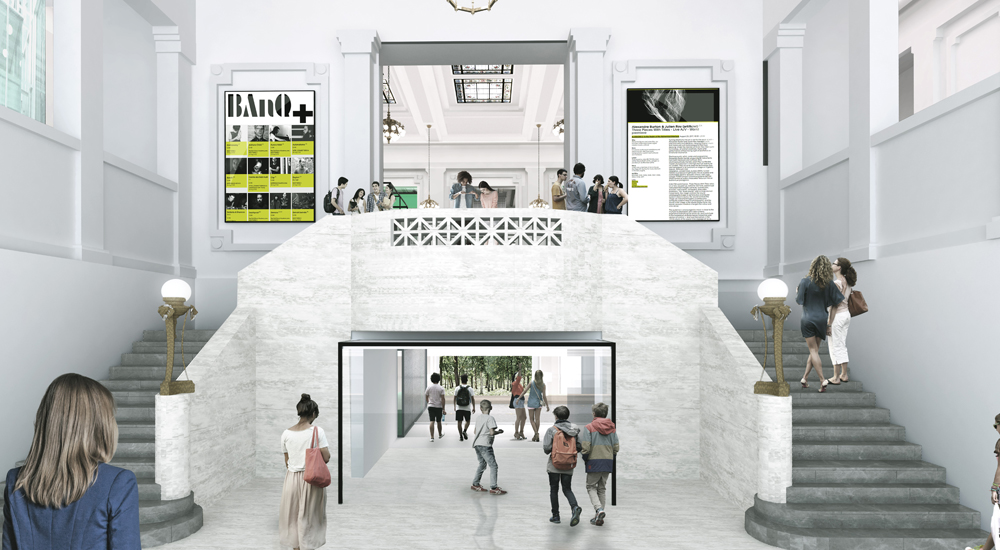
This project aims to give the Saint-Sulpice library its original function of sharing knowledge, exploring knowledge and breaking down social barriers, but in a renewed form that revolves around two major complementary axes. :
- A space of innovation and creation centered on new technologies and aimed at a diversified clientele (medialab and fablab).
- A space specifically dedicated for teenagers (library).

The development of the new functions within the Saint-Sulpice Library must take into account the sometimes dichotomous needs of the various clienteles and the multiple activities that can be realized simultaneously or successively, at very different times and with groups of different sizes. In addition, it is essential that the space can be flexible and adaptable according to the different needs and technologies that will appear during its existence. In this context, several issues and challenges emerge from the redevelopment and transformation project of the Saint-Sulpice Library to accommodate its new functions.

Beyond the functionalities, programs and services, the central objective of the laboratory-library is to set up an integrated environment allowing all its users to become acquainted with new technologies through experimentation, creativity and innovation, in order to be able to translate these learnings into real life. It must support the concrete discovery of fields of interest that can also contribute to the emergence of passions, choices or career changes, personal or group commitments in the context of discussions or societal debates.

(From competition program)

(Unofficial automated translation)