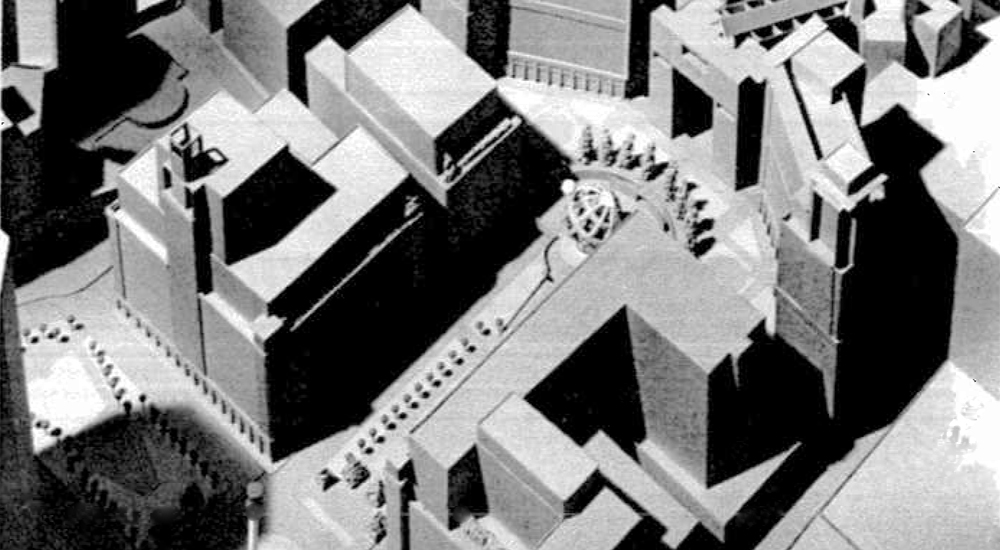
Cité internationale de Montréal
1990
Montréal, Quebec, Canada- Planning
- Districts
- Quarters
The promoters of this international urban development competition have two main objectives:
1- the development of the sector by using the best inputs of advanced know-how and international talent in solving urban problems;
2 - an international emulation by retaining the solutions and possibly the professional teams most able to value the potential and vocations of the sector, I hopes polarizing the international functions of Montréal.
Advanced know-how
Candidates are asked to optimize an overall solution in the context of international expertise in relation to similar projects. Here we highlight some contextual considerations:
- the use of the air rights of the Ville-Marie motorway and the most appropriate technical solutions in terms of structure, ventilation, public safety, costs involved, and a highway both in trench and in a tunnel.
- the connections between the urban arterial highway network, the motorway network and the local service roads, as well as the distribution and accessibility of car parks and loading/unloading docks.
- the possible integration of a small public transit mode, connected to the existing metro network, to serve the old city (historic district of Old Montreal), the competition area, and the Business Center.
- respect for the built heritage, ensuring the continuity of the urban fabric rather than breaking its links.
- solutions to be considered taking into account Montréal's rigorous climate (fountains, snow removal, district heating, sheltered pedestrian networks, winter recreation, etc.).
- the development of public spaces and existing monuments.
- lighting designed for vehicular traffic, pedestrian traffic, and the enhancement of the built environment.
International Emulation
Participants are asked to identify, for the competition sector, elements capable of confirming Montréal's international vocation, as much in terms of vocations (soil affections and vocation of buildings) as in the urban fabric. They are therefore expected to be somewhat familiar with similar efforts by other global cities, particularly those hosting the permanent headquarters of international organizations and engaging the business community and industry In the joint construction of commercial buildings and large assembly facilities.
(From competition program)
(Unofficial automated translation)
1- the development of the sector by using the best inputs of advanced know-how and international talent in solving urban problems;
2 - an international emulation by retaining the solutions and possibly the professional teams most able to value the potential and vocations of the sector, I hopes polarizing the international functions of Montréal.
Advanced know-how
Candidates are asked to optimize an overall solution in the context of international expertise in relation to similar projects. Here we highlight some contextual considerations:
- the use of the air rights of the Ville-Marie motorway and the most appropriate technical solutions in terms of structure, ventilation, public safety, costs involved, and a highway both in trench and in a tunnel.
- the connections between the urban arterial highway network, the motorway network and the local service roads, as well as the distribution and accessibility of car parks and loading/unloading docks.
- the possible integration of a small public transit mode, connected to the existing metro network, to serve the old city (historic district of Old Montreal), the competition area, and the Business Center.
- respect for the built heritage, ensuring the continuity of the urban fabric rather than breaking its links.
- solutions to be considered taking into account Montréal's rigorous climate (fountains, snow removal, district heating, sheltered pedestrian networks, winter recreation, etc.).
- the development of public spaces and existing monuments.
- lighting designed for vehicular traffic, pedestrian traffic, and the enhancement of the built environment.
International Emulation
Participants are asked to identify, for the competition sector, elements capable of confirming Montréal's international vocation, as much in terms of vocations (soil affections and vocation of buildings) as in the urban fabric. They are therefore expected to be somewhat familiar with similar efforts by other global cities, particularly those hosting the permanent headquarters of international organizations and engaging the business community and industry In the joint construction of commercial buildings and large assembly facilities.
(From competition program)
(Unofficial automated translation)
