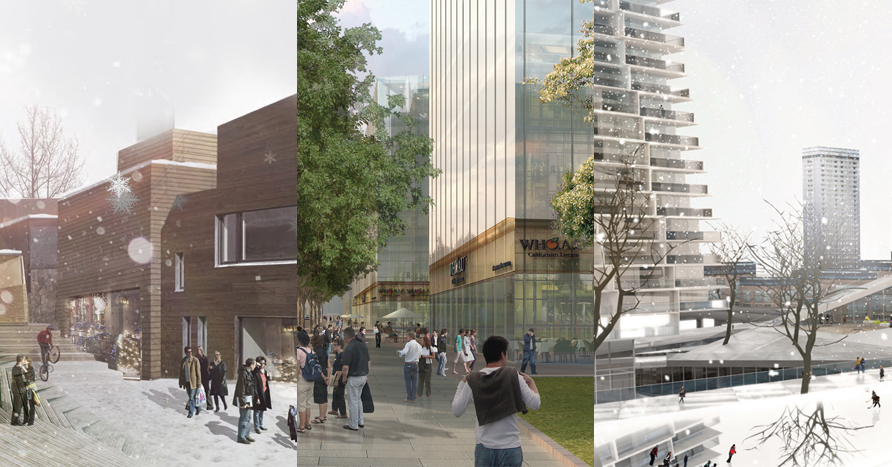
Gardiner Expressway and Lake Shore Boulevard Reconfiguration / Reconfiguration de l'autoroute Gardiner et du boulevard Lake Shore
2009
Toronto, Ontario, Canada- Planning
- Districts
- Development area
The fundamental purpose of this design exercise is to foster an informed public discourse that ultimately leads to general consensus on the appropriate future for the Gardiner Expressway. Compelling visions are needed for each option under consideration - whether the Gardiner Expressway is to be retained, replaced, or removed - demonstrating how this area can be transformed into a sustainable and beautiful waterfront destination without making the downtown core inaccessible.
To date, the public discussion about the future of the Gardiner Expressway has centered on whether it is more of a barrier if it (and its traffic) is kept up versus if it (and its traffic) is brought down to grade. But missing from this debate have been strong design propositions that demonstrate the full potential of each approach to foster waterfront revitalization. Instead, competing assumptions have been made, such as "if it is retained it could be made beautiful underneath" or "if it is removed the waterfront will become integrated with the downtown core." In reality, each of these approaches could be done well or done poorly. What is needed is a series of tangible, compelling visions that allow each approach to be evaluated on its own merits as well as through a side-by-side comparison.
The design ideas selected out of this exercise will help form the basis of a detailed environmental review that will examine: 1) Improve the urban fabric while maintaining the existing expressway; 2) Replace with a new above or below grade expressway; and 3) Remove the elevated expressway and build a new boulevard. Each of the proposals will have to balance the regional transportation needs of Canada's largest city with the city-building goals of creating a sustainable and beautiful waterfront neighbourhood.
To ensure that the environmental assessment process builds upon these broader goals, each of the design proposals will be studied through four lenses: 1) environment; 2) economics; 3) transportation and infrastructure; and 4) urban design. The framework of the lenses is meant to broaden the discussion beyond transportation and ensure that the multiple objectives of the exercise are evaluated throughout the legislated environmental assessment process.
While a major capital investment in the Gardiner Expressway may not be needed, or pursued, immediately, a decision about its future is needed now in order to move forward other revitalization efforts. For example, if it is to stay, the rights-of-way and intersections beneath are likely to be transformed, thus affecting where new utilities should (or should not) be placed. Similarly, if a new highway is to be built or an at-grade boulevard is envisioned, its future alignment must be protected as new buildings go up in the area. Therefore, in any scenario, decisions about new development, open space, transit, roads, and utilities will all be affected. Thus, galvanizing support for a decision may be the most important product of the environmental assessment of which this exercise is an important part.
Given this reality, two broad goals have been set that govern this design exercise:
#1 - Create inspiring visions for the Gardiner/Lake Shore Corridor as part of a revitalized waterfront.
#2 - Facilitate a public dialogue on the future of this piece of infrastructure so revitalization can proceed.
(From competition brief)
To date, the public discussion about the future of the Gardiner Expressway has centered on whether it is more of a barrier if it (and its traffic) is kept up versus if it (and its traffic) is brought down to grade. But missing from this debate have been strong design propositions that demonstrate the full potential of each approach to foster waterfront revitalization. Instead, competing assumptions have been made, such as "if it is retained it could be made beautiful underneath" or "if it is removed the waterfront will become integrated with the downtown core." In reality, each of these approaches could be done well or done poorly. What is needed is a series of tangible, compelling visions that allow each approach to be evaluated on its own merits as well as through a side-by-side comparison.
The design ideas selected out of this exercise will help form the basis of a detailed environmental review that will examine: 1) Improve the urban fabric while maintaining the existing expressway; 2) Replace with a new above or below grade expressway; and 3) Remove the elevated expressway and build a new boulevard. Each of the proposals will have to balance the regional transportation needs of Canada's largest city with the city-building goals of creating a sustainable and beautiful waterfront neighbourhood.
To ensure that the environmental assessment process builds upon these broader goals, each of the design proposals will be studied through four lenses: 1) environment; 2) economics; 3) transportation and infrastructure; and 4) urban design. The framework of the lenses is meant to broaden the discussion beyond transportation and ensure that the multiple objectives of the exercise are evaluated throughout the legislated environmental assessment process.
While a major capital investment in the Gardiner Expressway may not be needed, or pursued, immediately, a decision about its future is needed now in order to move forward other revitalization efforts. For example, if it is to stay, the rights-of-way and intersections beneath are likely to be transformed, thus affecting where new utilities should (or should not) be placed. Similarly, if a new highway is to be built or an at-grade boulevard is envisioned, its future alignment must be protected as new buildings go up in the area. Therefore, in any scenario, decisions about new development, open space, transit, roads, and utilities will all be affected. Thus, galvanizing support for a decision may be the most important product of the environmental assessment of which this exercise is an important part.
Given this reality, two broad goals have been set that govern this design exercise:
#1 - Create inspiring visions for the Gardiner/Lake Shore Corridor as part of a revitalized waterfront.
#2 - Facilitate a public dialogue on the future of this piece of infrastructure so revitalization can proceed.
(From competition brief)