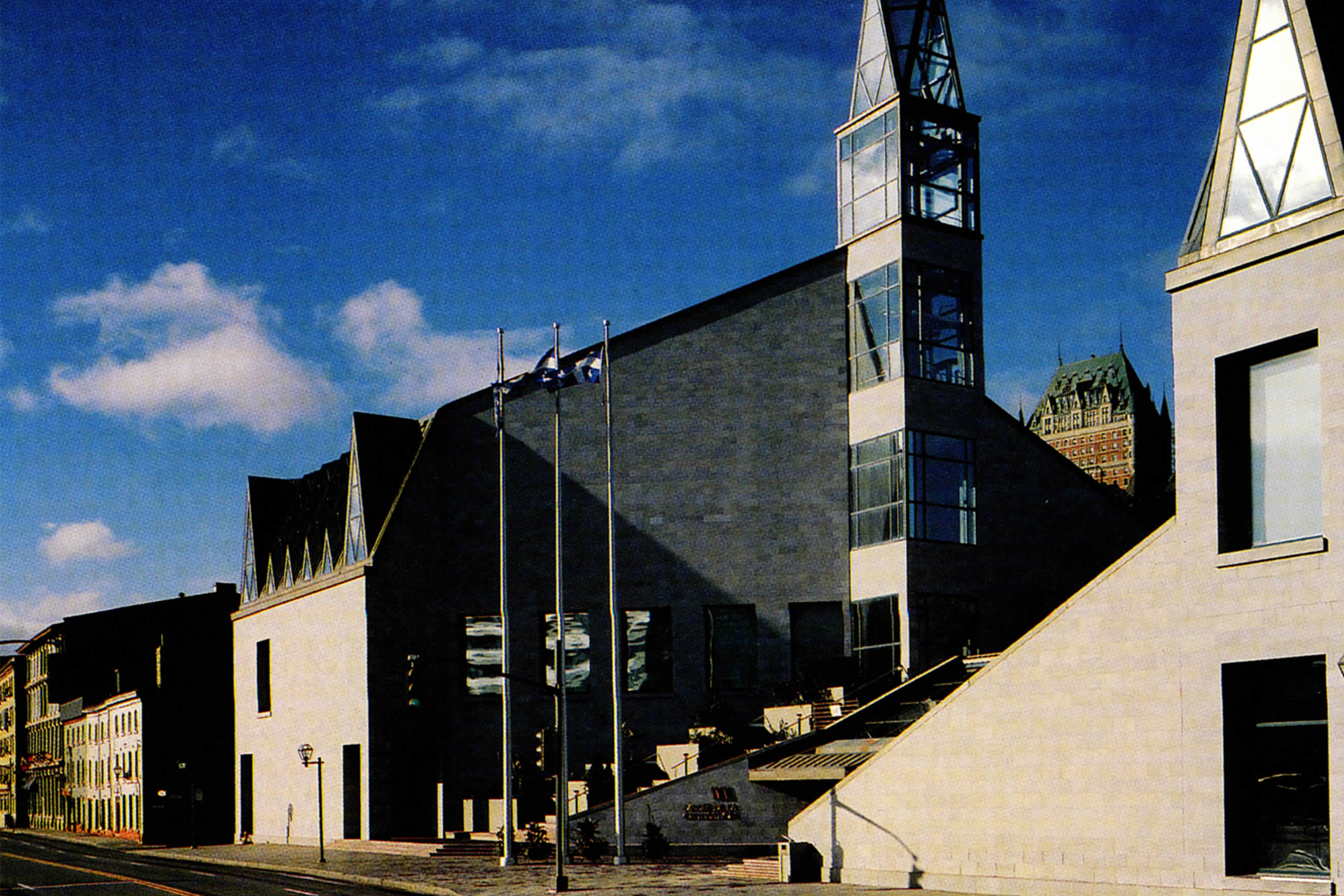
Musée national de la civilisation / National Museum of Civilization
1980
Québec City, Quebec, Canada- Architecture for culture, research, sport or leisure
- Building
- Museum
CREATION OF A NATIONAL MUSEUM OF CIVILISATION
On the 9Th of December 1980, the decree 80-215 officialised the government decision to build a national Museum of Civilisation in Quebec.
Many objectives will be reached simultaneously by the achievement of this project:
- The creation of the Museum of Civilization will compensate for the lack of a museum dedicated to show the many particularities of our civilization, its origins, its evolution and the various influences that have transformed it.
- The new institution will be gifted with sufficient space to display an important collection of ethnologic items that the limited space of the Museum of Québec never permitted to show until now.
- The celebration of major international cultural events will be supported and facilitated by the equipment designed according to international norms and standards.
- The future Museum will possess all the facilities to respond to various animation programs, conferences and pedagogic workshop, which are essential to fully comprehend the exposition. All of these museum animation services will facilitate access to cultural activities, that are actually available in the majority of modern countries, for the whole population.
Not only the will the project will be a key instrument to achieve museum mission, it will also contribute to revitalize the lower city sector, near the Place Royale, where the Museum will be built.
HOLDING A COMPETITION TO SELECT A PROJECT
According to the government procedure, that provides the holding of a design competition for big scope projects, the Ministry of public Works and Supply intend to benefit from the experience gained during the realization of the two last design competitions.
However, we can affirm that the procedure remained quite unchanged since the Courthouse of Quebec design competition, held during the summer of 1979.
Nonetheless, the specific realization requirements of this project of the national Museum of Civilization reflect themselves in the competition design significance. Indeed, the Ministry plan to execute this project in two distinctive phases. The competition covers the conceptualization of the whole project, but intend to prepare the plans and estimates for the first phase only.
Thus, none of the directives regarding the second phase of the project should be interpreted as a commitment from the Ministry to the competitors.
INTERVENTION PHILOSOPHY
The construction of the national Museum of Civilization, associated with recycling and rehabilitation projects actually ongoing on the Place Royale and the Petit Champlain Street, and eventually at the University of Quebec in the Old Port, will certainly contribute to enhance this harbour neighbourhood of the Lower City that was overlook by socio-economic changes of the past decades. Also, it is interesting to note that the new museum will be erected at the exact same place that the civilization it celebrates was originally rooted.
However, the conception of the project present challenges beyond its technical consideration. Clearly, the imagination and the creative skills of the competitors will be put to test. Indeed, the insertion of a new building in an historic and venerated urban grid demand a high sense of sensibility and refinement.
In a historic area, new architecture must assert itself while respecting the rich cultural vestige of the past. The balance of scale, rythme and architectural vocabulary must connect and complement the old with the new. The creator should inspire himself with the observation and the meticulous analysis of the specific landscape of the future project; the limits of this landscape expand far away from the building site boundaries. If the functionality of the project justifies it, the creator could then interpret and integrate these particularities to the project; size, volumetry, proportions, materials, textures and colors are composition elements that can confirm an effort of integration and continuity, if used repeatedly.
It is wrong to believe that the contemporary intervention should appear timid and camouflaged. In the contrary, it should be proud, fierce and original, but also subtle, sober and aware of the historic nature of the area. The harmony of the forms, the nobility of the materials and the refinement in the details prevail on the ambitious and extravagant architectural manifestations.
In historic area, the preservation and the enhancement of the old structures are primordial. Instead of what is often seen elsewhere, the addition of new building must contribute to enhance and improve the old urban grid, not denature it.
It is frequent to refer to contrasting strategies regarding the insertion of a new construction in a historic urban grid. However, this concept needs to be interpreted with care and judgement. Conventional architectural forms are naturally and inevitably perturbed when the rules of traditional construction, definition and order of interior spaces are transgressed by the creative genius of the architect. As the Georges Pompidou Cultural Centre in Paris brilliantly demonstrate it, a contrasting approach then become a demonstration of change and progress and constitute a community enrichment. According to this point of view, an intervention based on contrast is desirable because it is not the result of a voluntary and free action by which the architect show his style and personality, but the result of the evolution of mind and human behaviour. Although, if transgressing the rules demands a genius mind, taming the forms demands talent: " Talent without genius is very little. Genius without talent is nothing" (Valéry).
(From competition program)
(Unofficial automated translation)
On the 9Th of December 1980, the decree 80-215 officialised the government decision to build a national Museum of Civilisation in Quebec.
Many objectives will be reached simultaneously by the achievement of this project:
- The creation of the Museum of Civilization will compensate for the lack of a museum dedicated to show the many particularities of our civilization, its origins, its evolution and the various influences that have transformed it.
- The new institution will be gifted with sufficient space to display an important collection of ethnologic items that the limited space of the Museum of Québec never permitted to show until now.
- The celebration of major international cultural events will be supported and facilitated by the equipment designed according to international norms and standards.
- The future Museum will possess all the facilities to respond to various animation programs, conferences and pedagogic workshop, which are essential to fully comprehend the exposition. All of these museum animation services will facilitate access to cultural activities, that are actually available in the majority of modern countries, for the whole population.
Not only the will the project will be a key instrument to achieve museum mission, it will also contribute to revitalize the lower city sector, near the Place Royale, where the Museum will be built.
HOLDING A COMPETITION TO SELECT A PROJECT
According to the government procedure, that provides the holding of a design competition for big scope projects, the Ministry of public Works and Supply intend to benefit from the experience gained during the realization of the two last design competitions.
However, we can affirm that the procedure remained quite unchanged since the Courthouse of Quebec design competition, held during the summer of 1979.
Nonetheless, the specific realization requirements of this project of the national Museum of Civilization reflect themselves in the competition design significance. Indeed, the Ministry plan to execute this project in two distinctive phases. The competition covers the conceptualization of the whole project, but intend to prepare the plans and estimates for the first phase only.
Thus, none of the directives regarding the second phase of the project should be interpreted as a commitment from the Ministry to the competitors.
INTERVENTION PHILOSOPHY
The construction of the national Museum of Civilization, associated with recycling and rehabilitation projects actually ongoing on the Place Royale and the Petit Champlain Street, and eventually at the University of Quebec in the Old Port, will certainly contribute to enhance this harbour neighbourhood of the Lower City that was overlook by socio-economic changes of the past decades. Also, it is interesting to note that the new museum will be erected at the exact same place that the civilization it celebrates was originally rooted.
However, the conception of the project present challenges beyond its technical consideration. Clearly, the imagination and the creative skills of the competitors will be put to test. Indeed, the insertion of a new building in an historic and venerated urban grid demand a high sense of sensibility and refinement.
In a historic area, new architecture must assert itself while respecting the rich cultural vestige of the past. The balance of scale, rythme and architectural vocabulary must connect and complement the old with the new. The creator should inspire himself with the observation and the meticulous analysis of the specific landscape of the future project; the limits of this landscape expand far away from the building site boundaries. If the functionality of the project justifies it, the creator could then interpret and integrate these particularities to the project; size, volumetry, proportions, materials, textures and colors are composition elements that can confirm an effort of integration and continuity, if used repeatedly.
It is wrong to believe that the contemporary intervention should appear timid and camouflaged. In the contrary, it should be proud, fierce and original, but also subtle, sober and aware of the historic nature of the area. The harmony of the forms, the nobility of the materials and the refinement in the details prevail on the ambitious and extravagant architectural manifestations.
In historic area, the preservation and the enhancement of the old structures are primordial. Instead of what is often seen elsewhere, the addition of new building must contribute to enhance and improve the old urban grid, not denature it.
It is frequent to refer to contrasting strategies regarding the insertion of a new construction in a historic urban grid. However, this concept needs to be interpreted with care and judgement. Conventional architectural forms are naturally and inevitably perturbed when the rules of traditional construction, definition and order of interior spaces are transgressed by the creative genius of the architect. As the Georges Pompidou Cultural Centre in Paris brilliantly demonstrate it, a contrasting approach then become a demonstration of change and progress and constitute a community enrichment. According to this point of view, an intervention based on contrast is desirable because it is not the result of a voluntary and free action by which the architect show his style and personality, but the result of the evolution of mind and human behaviour. Although, if transgressing the rules demands a genius mind, taming the forms demands talent: " Talent without genius is very little. Genius without talent is nothing" (Valéry).
(From competition program)
(Unofficial automated translation)