
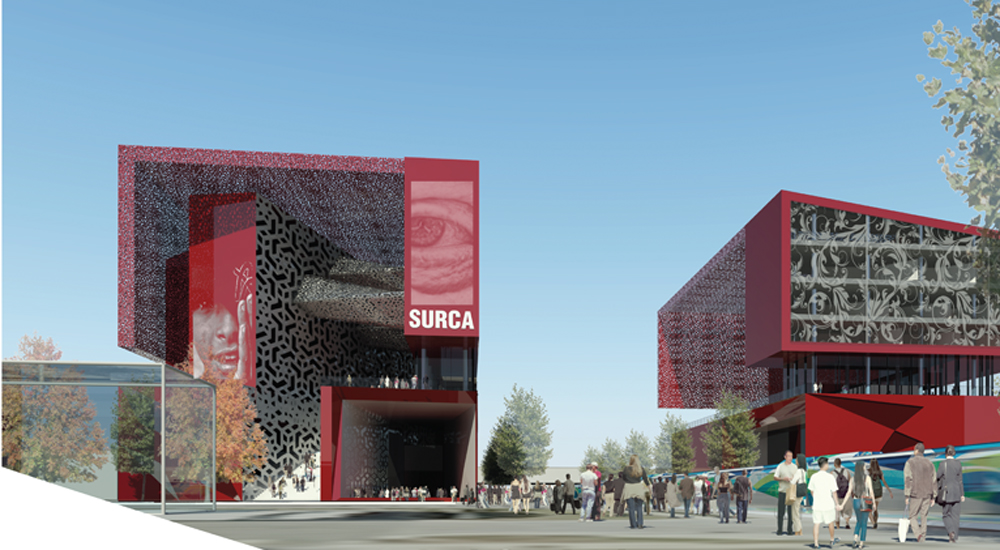
TOWNSHIFT Suburb into City / Guildford : Cornered
2009
Surrey, British Columbia, Canada- Public building
- Urban spaces
- City blocks
''TownShift: Suburb into City'' is open an international ideas competition seeking innovative ideas for five of Surrey's established Town Centres: Guildford, Fleetwood, Cloverdale, Newton and Semiahmoo. The aim of the competition is to ''Shift'' thinking and opportunities for each of these ''Town'' hubs towards more intense, public-minded and productive urban futures. Approved by the Architectural Institute of British Columbia, this competition is proposed in order to generate innovative new thinking about suburbs transforming towards sustainability in an era of increasingly expensive energy. TownShift has been conceived to open up debate and communicate design ideas amongst the general public and city-building professions, and we hope its results will shape this rapidly-evolving city for decades to come. Indeed, the civic slogan proudly displayed on Surrey's new urban brand is ''The Future Lives Here.''
The Challenge
Guildford is known for two things: the Really Big Canadian Flag, and shopping. The flag-nearly as high as the Sheraton hotel tower across the street-is a legacy of Expo 86. After the fair concluded, the 280 foot high pole was bought by a Surrey car dealer and re-erected at the front of their lot, the dealership getting the almost inevitable name of ''Flag Motors.'' The flag is clearly visible miles away along the Trans-Canada Highway, and until the completion of architect Bing Thom's Central City, the big flag was likely Surrey's most high profile visual icon. Indicative of the importance of architecture to Surrey's self-image, an abstraction of Bing Thom's superb design has since recently integrated into the City's official civic logo and brand.
This is one of the most important retail nodes in the entire Lower Mainland, home to Guildford Mall (only Burnaby's Metrotown is larger.) Extending out from the shopping centre in nearly every direction are blocks and blocks of strip malls in multiple variations, car dealerships, hotels, gas stations, and almost every franchise business imaginable. Other than a compact public campus to the west of 152nd Street and north of the mall which includes a library and recreation buildings, there is precious little public realm here, difficult walking conditions, no place of repose, nothing to make you realize you are in Guildford, or Surrey for that matter. Moreover-and accentuating these problems-there is also precious little housing in Guildford Town Centre's core.
The intersection of 152nd Street and 104th Avenue is one of the busiest in Surrey. Both streets connect onto interchanges on the Trans-Canada Highway, meaning this corner is busy and noisy day and night. The two corners on the west side of 152nd are empty-one the site of a former gas station undergoing soil remediation, the sister corner to the north devoted to mall parking. These two corners represent one of the most difficult but important of all suburban design challenges-how to temper the visual and social impact of a mall ‘floating' like an ocean-liner on a huge parking lot. How to do this without recourse to the standard European urban repertoire of plaza, piazetta or mews is the real challenge here, as the reality of ongoing noise and distraction mean all of these are unlikely solutions.
(From competition documentation)
The Challenge
Guildford is known for two things: the Really Big Canadian Flag, and shopping. The flag-nearly as high as the Sheraton hotel tower across the street-is a legacy of Expo 86. After the fair concluded, the 280 foot high pole was bought by a Surrey car dealer and re-erected at the front of their lot, the dealership getting the almost inevitable name of ''Flag Motors.'' The flag is clearly visible miles away along the Trans-Canada Highway, and until the completion of architect Bing Thom's Central City, the big flag was likely Surrey's most high profile visual icon. Indicative of the importance of architecture to Surrey's self-image, an abstraction of Bing Thom's superb design has since recently integrated into the City's official civic logo and brand.
This is one of the most important retail nodes in the entire Lower Mainland, home to Guildford Mall (only Burnaby's Metrotown is larger.) Extending out from the shopping centre in nearly every direction are blocks and blocks of strip malls in multiple variations, car dealerships, hotels, gas stations, and almost every franchise business imaginable. Other than a compact public campus to the west of 152nd Street and north of the mall which includes a library and recreation buildings, there is precious little public realm here, difficult walking conditions, no place of repose, nothing to make you realize you are in Guildford, or Surrey for that matter. Moreover-and accentuating these problems-there is also precious little housing in Guildford Town Centre's core.
The intersection of 152nd Street and 104th Avenue is one of the busiest in Surrey. Both streets connect onto interchanges on the Trans-Canada Highway, meaning this corner is busy and noisy day and night. The two corners on the west side of 152nd are empty-one the site of a former gas station undergoing soil remediation, the sister corner to the north devoted to mall parking. These two corners represent one of the most difficult but important of all suburban design challenges-how to temper the visual and social impact of a mall ‘floating' like an ocean-liner on a huge parking lot. How to do this without recourse to the standard European urban repertoire of plaza, piazetta or mews is the real challenge here, as the reality of ongoing noise and distraction mean all of these are unlikely solutions.
(From competition documentation)
