
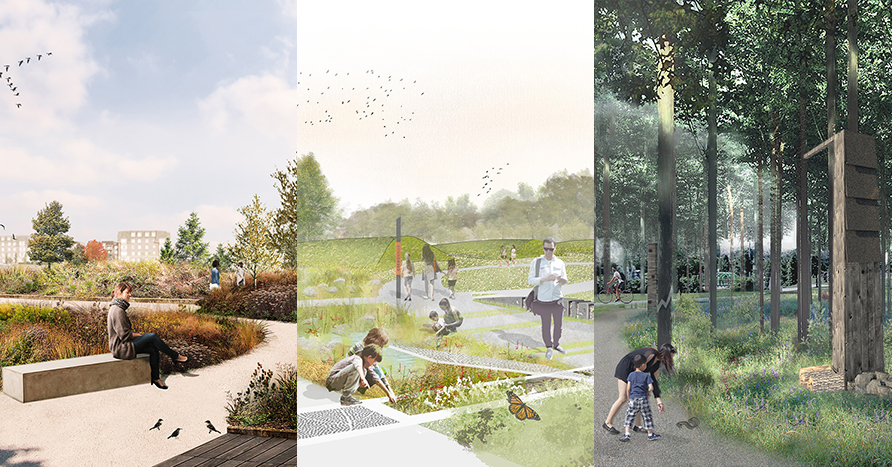
Créer le corridor de biodiversité à Saint-Laurent / Creating a Biodiversity Corridor in Saint-Laurent
2017
Montréal, Quebec, Canada- Landscaping
- Territory
- District
This project competition is:
• a multidisciplinary landscape architecture competition;
• national in scope;
• held in two stages: the first consisting of anonymous proposals, the second consisting of service offerings prepared by four jury-selected finalists.
(From website)
With an industrial park covering approximately 70% of its territory, Saint-Laurent is one of the boroughs with the most significant heat islands in the Montreal area. Habitats conducive to biodiversity are fragmented by barriers such as highways 40 and 13, the major boulevards Cavendish, Henri-Bourassa, and Thimens, as well as residential, commercial, and industrial developments.
[...]
The borough of Saint-Laurent aims to develop the Cavendish-Laurin-Liesse biodiversity corridor. To this end, a master development plan will be drawn up to define the orientations and interventions to be prioritized for the implementation of the corridor on the territory.
Situated at the crossroads of natural and urbanized environments, the corridor project calls on a variety of disciplines and will contribute to the conservation of environments of interest and the protection of biodiversity, notably through interventions to improve wildlife habitat and increase vegetation cover, in addition to offering residents various routes that will become both recreational destinations for outdoor activities and physical exercise, and connections with the borough's various hubs, cultural attractions and living environments.
Ecological connectivity is an essential quality of a biodiversity corridor, ensuring "the maintenance of biodiversity [...] by enabling species to disperse and migrate". It consists in linking landscape elements (natural environments, green spaces, islands of greenery, etc.) together, to enable wildlife species to carry out all or part of their life cycle. A biodiversity corridor is therefore made up of one or more natural infrastructures that establish a better connection between fragmented habitats and natural environments in the area. This connection can be aerial (non-continuous islands of greenery for birds or insects, for example) or terrestrial (continuous links and wildlife passages for foxes or amphibians, for example). Restoring ecological links is just as important as protecting existing natural environments, not only to ensure that populations are maintained, but also to ensure genetic exchange between them.
Thus, the creation of the Cavendish-Laurin-Liesse biodiversity corridor aims to meet two general objectives:
- To consolidate the biodiversity corridor's environmental, social and cultural assets;
- Connect these assets to create ecological connections and citizen trails.
(From competition program)
(Unofficial automated translation)
• a multidisciplinary landscape architecture competition;
• national in scope;
• held in two stages: the first consisting of anonymous proposals, the second consisting of service offerings prepared by four jury-selected finalists.
(From website)
With an industrial park covering approximately 70% of its territory, Saint-Laurent is one of the boroughs with the most significant heat islands in the Montreal area. Habitats conducive to biodiversity are fragmented by barriers such as highways 40 and 13, the major boulevards Cavendish, Henri-Bourassa, and Thimens, as well as residential, commercial, and industrial developments.
[...]
The borough of Saint-Laurent aims to develop the Cavendish-Laurin-Liesse biodiversity corridor. To this end, a master development plan will be drawn up to define the orientations and interventions to be prioritized for the implementation of the corridor on the territory.
Situated at the crossroads of natural and urbanized environments, the corridor project calls on a variety of disciplines and will contribute to the conservation of environments of interest and the protection of biodiversity, notably through interventions to improve wildlife habitat and increase vegetation cover, in addition to offering residents various routes that will become both recreational destinations for outdoor activities and physical exercise, and connections with the borough's various hubs, cultural attractions and living environments.
Ecological connectivity is an essential quality of a biodiversity corridor, ensuring "the maintenance of biodiversity [...] by enabling species to disperse and migrate". It consists in linking landscape elements (natural environments, green spaces, islands of greenery, etc.) together, to enable wildlife species to carry out all or part of their life cycle. A biodiversity corridor is therefore made up of one or more natural infrastructures that establish a better connection between fragmented habitats and natural environments in the area. This connection can be aerial (non-continuous islands of greenery for birds or insects, for example) or terrestrial (continuous links and wildlife passages for foxes or amphibians, for example). Restoring ecological links is just as important as protecting existing natural environments, not only to ensure that populations are maintained, but also to ensure genetic exchange between them.
Thus, the creation of the Cavendish-Laurin-Liesse biodiversity corridor aims to meet two general objectives:
- To consolidate the biodiversity corridor's environmental, social and cultural assets;
- Connect these assets to create ecological connections and citizen trails.
(From competition program)
(Unofficial automated translation)