
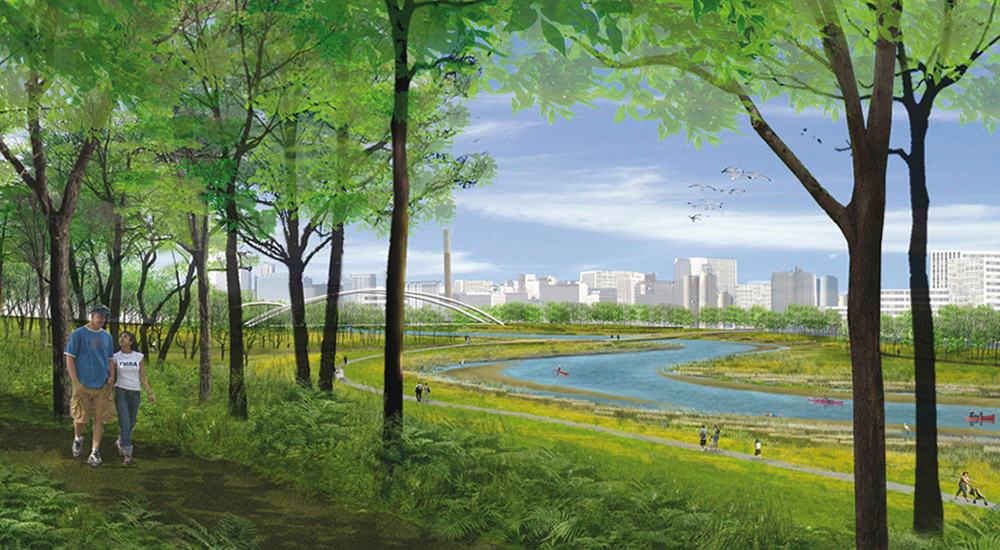
Lower Don Lands Design Competition / Concours de design pour les terres du Bas-Don
2007
Toronto, Ontario, Canada- Architecture for culture, research, sport or leisure
- Urban spaces
- District
Design Competition Website: <a href="http://www.waterfrontoronto.ca/lower_don_lands/lower_don_lands_design_competition">Lower Don Lands Design Competition</a> <br><br>
LOWER DON LANDS DESIGN COMPETITION DESCRIPTION <br><br>
The Toronto Waterfront Revitalization Corporation (TWRC) was established in 2001 by the Government of Canada, the Province of Ontario, and the City of Toronto to lead and oversee the renewal of Toronto's central waterfront. The TWRC's mission is to put Toronto at the forefront of global cities in the 21st century by transforming the waterfront into beautiful and sustainable communities, fostering economic growth in knowledge-based, creative industries, and ultimately redefining how Toronto, Ontario, and Canada are perceived by the world. In the Lower Don Lands, naturalizing the mouth of the Don River and integrating it harmoniously with new waterfront redevelopment and transportation infrastructure are key priorities for the TWRC and its partners. <br><br>
The Toronto and Region Conservation (TRCA) main objectives are to restore the health of the region's rivers and waters, promote a system of natural areas, facilitate sustainable living and city building, and pursue creative partnerships for delivering its projects. With funding from the TWRC, the TRCA has engaged a consultant to undertake an Environmental Assessment (EA) of the best means to naturalize the mouth of the Don River and protect more than 230 hectares in the Lower Don Lands vicinity from flood risk. <br><br>
Approximately $65 million has been earmarked for the naturalization of the Don River and reconstruction of any infrastructure directly impacted by this work. Additional phases of work may be implemented over time pending availability of additional funding. <br><br>
The TWRC, in cooperation with the TRCA and the City of Toronto and other government partners, is sponsoring an Innovative Design Competition to bring a fresh, new perspective to the 40-hectare Lower Don Lands, which represent one of the greatest opportunities to rebuild a river in an urban centre. Five teams representing a range of different urban and architectural design philosophies have been selected to participate in an eight-week design competition. The fundamental purpose of this design competition is to establish a common vision for this area, which has for decades been "on the perimeter" of various waterfront planning initiatives, but never treated as a centre of revitalization in and of itself. <br><br>
Given this wide range of challenges - from the general to the specific - there are two broad goals the Lower Don Lands Innovative Design Competition seeks to achieve: <br><br>
Goal #1: An iconic identity for the Don River that accommodates crucial flood protection and habitat restoration requirements. <br>
Goal #2: A bold and comprehensive concept design that integrates development, transportation infrastructure, and the river mouth into a harmonious whole. <br>
In order to achieve the goals described above, ten elements have been identified as required components of the proposals: <br><br>
01 | Naturalize the Mouth of the Don River <br>
02 | Create a Continuous Riverfront Park System <br>
03 | Provide for Harmonious New Development <br>
04 | Extend Queens Quay Eastward and Enhance the Road Network <br>
05 | Prioritize Public Transit <br>
06 | Develop a Gateway into the Port Lands <br>
07 | Humanize Existing Infrastructure <br>
08 | Enhance the Martin Goodman Trail <br>
09 | Expand Opportunities for Interaction with the Water <br>
10 | Promote Sustainable Development <br><br>
The designs should propose cost-effective solutions that will have as much impact as possible. They should also be conscious of the long-term maintenance implications, as the goal is for the river to become a self-sustaining ecosystem with as little human intervention as possible. <br><br>
JURY REPORT <br><br>
The jury deliberations included attending the public exhibition and presentations by the four competitors held at BCE Place on April 16. A walking and bus tour of the Lower Don Lands site was conducted on April 24. The jury met for two days, April 26 and 27, to formally review the designs and to select the winning scheme and team. The staff of the TWRC provided a broad overview of the competition requirements, site context, flood control and ecological issues, as well as patterns of land ownership and soil conditions. As part of their deliberations, the jury received presentations from three stakeholder groups. The Toronto and Region Conservation Authority (TRCA) coordinated an Environmental Assessment Technical Group to provide an overview of the ecological and hydrological feasibility analysis and a high level costing for each design concept. A City of Toronto Technical Team provided a staff overview of comments received from each of the relevant City departments including urban planning and design, parks, heritage and culture, water, and municipal servicing. The City team provided the jury with their identification of the strengths and weaknesses of the designs and provided thoughts on the teams' innovative approaches. <br><br>
John Wilson, Chair of the Lower Don Lands Stakeholder Committee, provided a summary of the group's response to each of the designs. The group prepared a report for the jury with detailed critiques of each design.
Kristin Jenkins of the TWRC provided the jury with a summary of the public comments collected during the BCE Place public exhibition, April 16 - 24. <br><br>
In addition to reviewing the design reports submitted by each competing team, the models of the competition schemes were set up for viewing at the offices of the TWRC specifically for the jury deliberations. <br><br>
Commissioners' Park <br><br>
The jury acknowledged the exemplary work of Claude Cormier in the design of Commissioners' Park which was completed before the idea of launching an international design competition for the mouth of the Lower Don was approved. Although Commissioner's Park is superseded by the naturalization of the mouth of the Don River, the park's recreational program was incorporated in different ways within each of the four submissions. <br><br>
TWRC Leadership and Stakeholder Collaboration <br><br>
The jury recognized the leadership role of the TWRC in promoting design excellence and innovation through international design competitions. And, the jury commended TWRC for its deep and consistent commitment to citizen participation and on-going stakeholder consultation. Finally, the jury appreciated the input of the stakeholder groups themselves---TRCA, City of Toronto, and the Lower Don Lands Stakeholder Committee. The jury was impressed by the quality of the information that was presented and the enthusiasm and passion the stakeholders have for the Lower Don Lands. <br><br>
Jury Comments <br><br>
The jury commended the outstanding and innovative work that each of the teams produced in a short period of time for such a complex undertaking. The jury was impressed by the quality and diversity of the multi-disciplinary teams which included significant participation from Toronto architects, urban designers and engineers. The jury selected the design by the team led by Michael van Valkenburgh and Associates as the winning design. This design was selected because the jury felt it best met the two major objectives of the competition which were to create a naturalized mouth and iconic identity for the Don River, and to deliver a comprehensive plan for addressing the area's ecological, urban design and transportation issues. The implementability of the MVVA team design was also an important consideration for the jury.
(From competition documentation)
LOWER DON LANDS DESIGN COMPETITION DESCRIPTION <br><br>
The Toronto Waterfront Revitalization Corporation (TWRC) was established in 2001 by the Government of Canada, the Province of Ontario, and the City of Toronto to lead and oversee the renewal of Toronto's central waterfront. The TWRC's mission is to put Toronto at the forefront of global cities in the 21st century by transforming the waterfront into beautiful and sustainable communities, fostering economic growth in knowledge-based, creative industries, and ultimately redefining how Toronto, Ontario, and Canada are perceived by the world. In the Lower Don Lands, naturalizing the mouth of the Don River and integrating it harmoniously with new waterfront redevelopment and transportation infrastructure are key priorities for the TWRC and its partners. <br><br>
The Toronto and Region Conservation (TRCA) main objectives are to restore the health of the region's rivers and waters, promote a system of natural areas, facilitate sustainable living and city building, and pursue creative partnerships for delivering its projects. With funding from the TWRC, the TRCA has engaged a consultant to undertake an Environmental Assessment (EA) of the best means to naturalize the mouth of the Don River and protect more than 230 hectares in the Lower Don Lands vicinity from flood risk. <br><br>
Approximately $65 million has been earmarked for the naturalization of the Don River and reconstruction of any infrastructure directly impacted by this work. Additional phases of work may be implemented over time pending availability of additional funding. <br><br>
The TWRC, in cooperation with the TRCA and the City of Toronto and other government partners, is sponsoring an Innovative Design Competition to bring a fresh, new perspective to the 40-hectare Lower Don Lands, which represent one of the greatest opportunities to rebuild a river in an urban centre. Five teams representing a range of different urban and architectural design philosophies have been selected to participate in an eight-week design competition. The fundamental purpose of this design competition is to establish a common vision for this area, which has for decades been "on the perimeter" of various waterfront planning initiatives, but never treated as a centre of revitalization in and of itself. <br><br>
Given this wide range of challenges - from the general to the specific - there are two broad goals the Lower Don Lands Innovative Design Competition seeks to achieve: <br><br>
Goal #1: An iconic identity for the Don River that accommodates crucial flood protection and habitat restoration requirements. <br>
Goal #2: A bold and comprehensive concept design that integrates development, transportation infrastructure, and the river mouth into a harmonious whole. <br>
In order to achieve the goals described above, ten elements have been identified as required components of the proposals: <br><br>
01 | Naturalize the Mouth of the Don River <br>
02 | Create a Continuous Riverfront Park System <br>
03 | Provide for Harmonious New Development <br>
04 | Extend Queens Quay Eastward and Enhance the Road Network <br>
05 | Prioritize Public Transit <br>
06 | Develop a Gateway into the Port Lands <br>
07 | Humanize Existing Infrastructure <br>
08 | Enhance the Martin Goodman Trail <br>
09 | Expand Opportunities for Interaction with the Water <br>
10 | Promote Sustainable Development <br><br>
The designs should propose cost-effective solutions that will have as much impact as possible. They should also be conscious of the long-term maintenance implications, as the goal is for the river to become a self-sustaining ecosystem with as little human intervention as possible. <br><br>
JURY REPORT <br><br>
The jury deliberations included attending the public exhibition and presentations by the four competitors held at BCE Place on April 16. A walking and bus tour of the Lower Don Lands site was conducted on April 24. The jury met for two days, April 26 and 27, to formally review the designs and to select the winning scheme and team. The staff of the TWRC provided a broad overview of the competition requirements, site context, flood control and ecological issues, as well as patterns of land ownership and soil conditions. As part of their deliberations, the jury received presentations from three stakeholder groups. The Toronto and Region Conservation Authority (TRCA) coordinated an Environmental Assessment Technical Group to provide an overview of the ecological and hydrological feasibility analysis and a high level costing for each design concept. A City of Toronto Technical Team provided a staff overview of comments received from each of the relevant City departments including urban planning and design, parks, heritage and culture, water, and municipal servicing. The City team provided the jury with their identification of the strengths and weaknesses of the designs and provided thoughts on the teams' innovative approaches. <br><br>
John Wilson, Chair of the Lower Don Lands Stakeholder Committee, provided a summary of the group's response to each of the designs. The group prepared a report for the jury with detailed critiques of each design.
Kristin Jenkins of the TWRC provided the jury with a summary of the public comments collected during the BCE Place public exhibition, April 16 - 24. <br><br>
In addition to reviewing the design reports submitted by each competing team, the models of the competition schemes were set up for viewing at the offices of the TWRC specifically for the jury deliberations. <br><br>
Commissioners' Park <br><br>
The jury acknowledged the exemplary work of Claude Cormier in the design of Commissioners' Park which was completed before the idea of launching an international design competition for the mouth of the Lower Don was approved. Although Commissioner's Park is superseded by the naturalization of the mouth of the Don River, the park's recreational program was incorporated in different ways within each of the four submissions. <br><br>
TWRC Leadership and Stakeholder Collaboration <br><br>
The jury recognized the leadership role of the TWRC in promoting design excellence and innovation through international design competitions. And, the jury commended TWRC for its deep and consistent commitment to citizen participation and on-going stakeholder consultation. Finally, the jury appreciated the input of the stakeholder groups themselves---TRCA, City of Toronto, and the Lower Don Lands Stakeholder Committee. The jury was impressed by the quality of the information that was presented and the enthusiasm and passion the stakeholders have for the Lower Don Lands. <br><br>
Jury Comments <br><br>
The jury commended the outstanding and innovative work that each of the teams produced in a short period of time for such a complex undertaking. The jury was impressed by the quality and diversity of the multi-disciplinary teams which included significant participation from Toronto architects, urban designers and engineers. The jury selected the design by the team led by Michael van Valkenburgh and Associates as the winning design. This design was selected because the jury felt it best met the two major objectives of the competition which were to create a naturalized mouth and iconic identity for the Don River, and to deliver a comprehensive plan for addressing the area's ecological, urban design and transportation issues. The implementability of the MVVA team design was also an important consideration for the jury.
(From competition documentation)