
Peacekeeping Monument
1991
Ottawa, Ontario, Canada- Funerary structures
- Monument
- Commemorative memorials
The Peacekeeping Monument
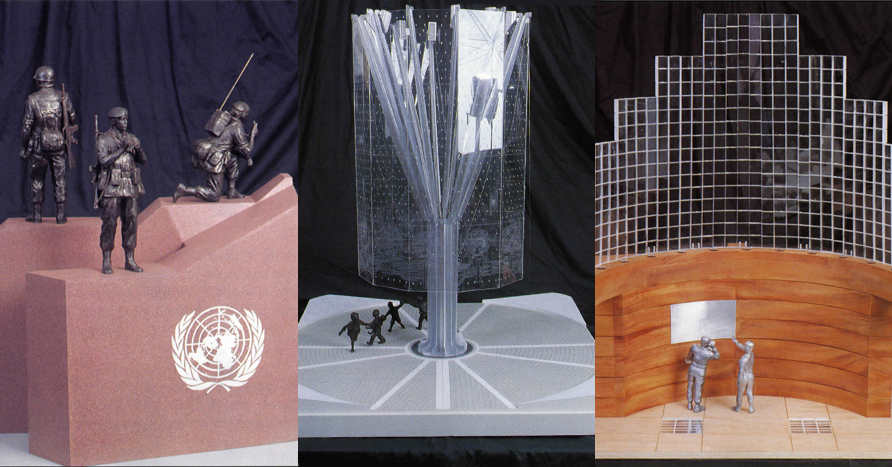
The Peacekeeping Monument acknowledges the pride that Canadians take in their peacekeeping role. Organizers worked to formulate a national competition that would inspire excellence not only in sculpture, but also in urban design.
The competition challenged artists and urban designers to contribute to the Capital's symbolic character. Dedicated to the Canadian peacekeepers of the past, present and future, the monument will be a timeless reminder of the contribution Canadian men and women have made to the international peacekeeping.
How Canada has changed in the last forty years is nowhere more apparent than in the contrasting dedications of the National War Memorial and the new Peacekeeping Monument. One honours those who died in war; the other honours those - living and dead - who have tried to maintain peace. Each has a place in our country's history.
The Design Challenge
Five sculptors and five urban designers were invited to form ten multi-disciplinary teams. Their entries were judge according to their success in symbolically capturing and expressing Canada's commitment to peacekeeping. The monument had to be artistically and technically excellent. At the same time, by incorporating figurative images that reflect all branches of the Armed forces, it was to be immediately meaningful to the Canadians public and to people visiting Canada's Capital from abroad.
The monument was required to respond in spirit, scale and orientation to the context provided by Confederation Boulevard, and with that of the whole Capital. The site is immediately adjacent to such major Capitol landmarks as the National Gallery and Notre-Dame basilica, and thus, it will become one of a "family" of significant Canadian places. Finally, the monument had to help create an inviting public space and a dignified venue for public ceremonies.
(From competition program)
The Peacekeeping Monument acknowledges the pride that Canadians take in their peacekeeping role. Organizers worked to formulate a national competition that would inspire excellence not only in sculpture, but also in urban design.
The competition challenged artists and urban designers to contribute to the Capital's symbolic character. Dedicated to the Canadian peacekeepers of the past, present and future, the monument will be a timeless reminder of the contribution Canadian men and women have made to the international peacekeeping.
How Canada has changed in the last forty years is nowhere more apparent than in the contrasting dedications of the National War Memorial and the new Peacekeeping Monument. One honours those who died in war; the other honours those - living and dead - who have tried to maintain peace. Each has a place in our country's history.
The Design Challenge
Five sculptors and five urban designers were invited to form ten multi-disciplinary teams. Their entries were judge according to their success in symbolically capturing and expressing Canada's commitment to peacekeeping. The monument had to be artistically and technically excellent. At the same time, by incorporating figurative images that reflect all branches of the Armed forces, it was to be immediately meaningful to the Canadians public and to people visiting Canada's Capital from abroad.
The monument was required to respond in spirit, scale and orientation to the context provided by Confederation Boulevard, and with that of the whole Capital. The site is immediately adjacent to such major Capitol landmarks as the National Gallery and Notre-Dame basilica, and thus, it will become one of a "family" of significant Canadian places. Finally, the monument had to help create an inviting public space and a dignified venue for public ceremonies.
(From competition program)
