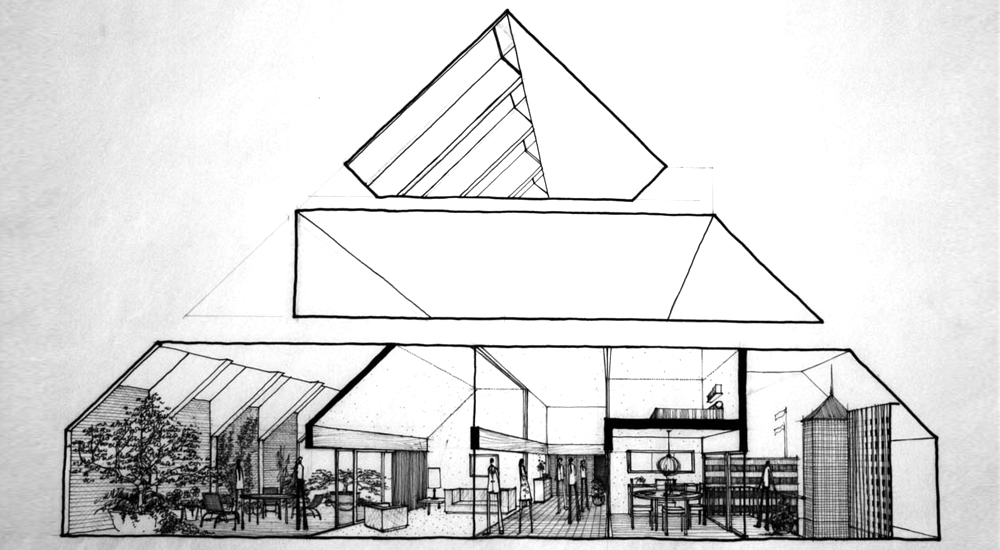
Pavillon du gouvernement canadien pour l'Exposition universelle d'Osaka 1970 / Canadian Government Pavilion Japan World Exposition Osaka 1970
1966
Osaka, Japan- Architecture for culture, research, sport or leisure
- Building
- Exhibition buildings
The construction of Expo 67 in Montreal was still in progress when Canada confirmed its participation in the next exhibition, Osaka 1970, becoming the first foreign country to confirm its presence at the Japanese exhibition. It was the first of its kind in Asia and its theme was "progress and harmony for humanity", with the aim of showing the world the image of a developed and avant-garde Japan.
The context of the organization of the competition for the Canadian pavilion in Osaka coincided with the post-war economic development, the baby boom, the Quebec Quiet Revolution, the centennial of the Canadian confederation and the 1967 Montreal World's Fair. There was a certain enthusiasm for world's fairs and the role that national pavilions could play in the diplomatic and cultural representation of the country abroad. Organized by the Department of Trade and Commerce and the Canadian Government Exhibition Commission, this competition brought together 208 architects, many of whom were also designers of buildings on the site of the Montreal exhibition.
Lasting six months, and with two stages of projects, this competition raised a debate on what would be the best image that Canada should bring to the Japanese exhibition. The jury's report made it clear that the pavilion must achieve a "strong and dramatic" image and that it must stand out from the other pavilions at the exhibition. In short, an image of self-confidence. Of the six finalist projects, the jury chose that of Vancouver architects Arthur Erickson and Geoffrey Massey, arguing that this project presented the most sensitive approach to the image of Canada and made a significant connection with Japanese aesthetic sensibilities.
(CCC text)
(Unofficial automated translation)
The context of the organization of the competition for the Canadian pavilion in Osaka coincided with the post-war economic development, the baby boom, the Quebec Quiet Revolution, the centennial of the Canadian confederation and the 1967 Montreal World's Fair. There was a certain enthusiasm for world's fairs and the role that national pavilions could play in the diplomatic and cultural representation of the country abroad. Organized by the Department of Trade and Commerce and the Canadian Government Exhibition Commission, this competition brought together 208 architects, many of whom were also designers of buildings on the site of the Montreal exhibition.
Lasting six months, and with two stages of projects, this competition raised a debate on what would be the best image that Canada should bring to the Japanese exhibition. The jury's report made it clear that the pavilion must achieve a "strong and dramatic" image and that it must stand out from the other pavilions at the exhibition. In short, an image of self-confidence. Of the six finalist projects, the jury chose that of Vancouver architects Arthur Erickson and Geoffrey Massey, arguing that this project presented the most sensitive approach to the image of Canada and made a significant connection with Japanese aesthetic sensibilities.
(CCC text)
(Unofficial automated translation)