
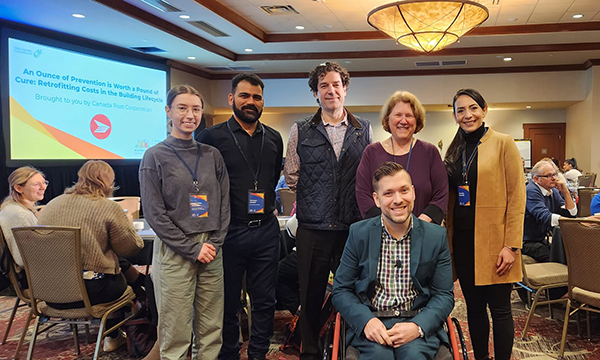
Students from Concordia, UdeM and Calgary participate in the Accessibility Professional Network Conference 2023 (RHF)

From left to right: Catherine Gauthier (MArch, Université de Montréal), Morteza Hazbei (PhD candidate, Concordia University), Jean-Pierre Chupin (UdeM), Doramy Ehling (CEO, Rick Hansen Foundation), Marco Pasqua (Rick Hansen Foundation), Nooshin Esmaeili (UCalgary)

On March 1-2, 2023, several student members of the SSHRC Quality Partnership were invited to participate in person or online in the annual APN2023 Building Together Symposium, which brought together industry leaders, accessibility professionals, and global thought leaders to discuss how we can continue to build an inclusive and accessible world for people of all ages and abilities. [Accessibility Professional Network 2023.](On March 1-2, 2023, several student members of the SSRC Quality Partnership were invited to participate in person or online in the annual APN2023 Building Together Symposium, which brought together industry leaders, accessibility professionals, and global thought leaders to discuss how we can continue to build an inclusive and accessible world for people of all ages and abilities. Accessibility Professional Network 2023.
A new LEAP seminar: “Material Cultures through the filter of the Cecobois and Woodworks Awards” by Izabel Amaral

March 16, 2023. A seminar presented by Izabel Amaral (UdeM) around a SSHRC Insight Development Grant: (in collaboration with Carmela Cucuzzella (Concordia) and Jean-Pierre Chupin (UdeM)

An Ecology of Wood Cultures in Canada (20032020): comparing constructive cultures through awarded architectural designs

At the  intersection of  architectural theory and  cultural studies, this  research investigates wood  architecture as a symbolic universe that allows us to study the presence of nature in human culture. This research will theorize the diversity of expressions of quality in Canadian architecture, from the standpoint of environmental preoccupation, building culture and architectural expression. Considering wood architecture as a form of “cultural ecology”, it has the potential to reveal how Canadian cultures represent and symbolize their relations to the land and natural resources, as well as the cultures of its founding peoples.

Notwithstanding the interest in wood as a major alternative to fossil fuelbased construction materials, this research will highlight the symbolic spectrum of wood buildings, which ranges from local and indigenous traditions to ecological aesthetics, representing forms of making that rely both on traditional architectural practice or recent building technologies and computeraided design. We aim to better interpret and understand how advancements in architectural practice and building techniques affect the way architecture is envisioned and materialized in Canada during the past decades. In parallel to studying the influence of environmental considerations to  architectural forms in  Canada, we  will make sense of  a  dissonance within the theory of architecture between ideas about the interdependency or autonomy of architectural form (visual appearance), material (what it is made of) and meaning (messages and ideals expressed).