Update to the Canadian Competitions Catalogue: Editorial by Yolene Handabaka for the ‘Reuse of the Olympic Roof’ competition

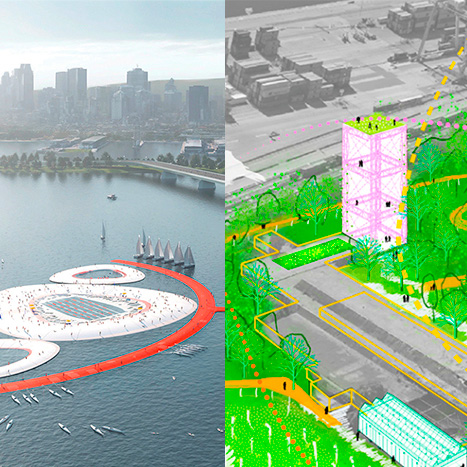
In this CCC update, we are publishing the 54 proposals submitted to the competition for the reuse of the Olympic roof in 2024.

Know more about the competition…

This editorial by Yolene Handabaka Ames, a PhD student in architecture, examines both the symbolic and environmental implications of this open-air project involving an icon of Quebec modernity – does it become a monument when its materials outlive the architecture itself?

Read the editorial…

“A semantic inventory of preconceived barriers to quality in Canada’s built environment”: New article in “Cities” by Jean-Pierre Chupin and Morteza Hazbei

« A semantic inventory of preconceived barriers to quality in Canada’s built environment », new article in the 175th volume of the journal Cities which will be published in August 2026.


Abstract

Traditional definitions of quality in architecture and the built environment have been increasingly challenged over the past decades, particularly through critical perspectives on spatial justice, equity, diversity, inclusion, and postcolonialism. Standardized definitions may reassure decision-makers but ignore evolving values reshaping quality. A Canadian SSHRC-funded research partnership is used as a testbed to examine how diverse stakeholders challenge conventional definitions of quality and propose new dimensions. This partnership functions as a living lab, bringing together representatives of citizens, municipalities, professionals, and academics to examine barriers to quality beyond traditional expertise. Drawing on the partnership’s open-access reports, the paper asks: What barriers to built environment quality do participants perceive when they convene around “partnership roundtables”? To address this question, the study develops a semantic inventory of key themes and barriers to quality using two methods: (1) a qualitative content analysis of the 2022 Montreal Convention reports, and (2) analysis of the extracted themes using a researcher-developed framework—disciplinary, managerial, and critical—to examine shifts in definitions of quality. A total of 96 “barriers to quality” were identified and grouped into seven themes. The most discussed included a) Communication and Engagement, b) Sustainability and Inclusivity (EDIA), and c) Programming, Design, Building, and Management. The findings show that the themes align mainly with critical definitions of quality, with little to no disciplinary representation. This suggests that citizens and public-sector stakeholders seek a broader redefinition of quality, and that these expectations are at odds with the traditional disciplinary values of architecture and related disciplines.

View the article…

WHAT IS NOT ACCESSIBLE IS NOT PUBLIC: New research funded by SSHRC (INSIGHT) aims to better understand and address the lack of accessibility in buildings and public spaces in Canada

Coordinated by the Canada Research Chair in Architecture, Competition and Quality at the Université de Montréal (Prof. Jean-Pierre Chupin), this project has received $412,000 in funding from the SSHRC’s INSIGHT programme (2026–2031). The interdisciplinary approach brings together researchers in interior design from the University of Montreal (Dr Olivier VallerandProf. Carmela Cucuzzella), in landscape architecture from the University of Toronto (Prof. Rob M. Wright) and in urban planning from Toronto Metropolitan University (Dr Samantha Biglieri).

Abstract

It is now clear that not all public buildings will be accessible by 2040, despite the adoption of the Canadian Accessibility Act (SC 2019, ch.10). By perpetuating barriers that effectively exclude people with disabilities, these spaces cannot fulfil their ‘public’ role.

In contrast to the progress made in environmental and sustainability issues, the lack of understanding of the spatial implications of experiences related to disability and special needs remains a major obstacle to educational, practical and policy responses across all disciplines of the built environment. Our previous research has demonstrated how awards for excellence and competitions influence definitions of quality in architecture, interior design, landscape architecture and urban planning.

We hypothesise that competitions and awards still reflect cultural and behavioural biases and do not meet the requirements of the Accessibility Act. Representations of users remain rooted in a worldview where the human body is idealised and standardised by simplistic images from which neurodiversity is conspicuously absent. We propose to make these ideological and procedural barriers explicit by theorising them through a series of comparative analyses of competition entries and awards for excellence in the Canadian context.

Using two databases compiled by our team (the Canadian Competition Catalogue and ArchiQualiData), the research focuses on around forty examples of public spaces at various scales identified within Canadian institutions, such as: cultural buildings, libraries, sports centres, state schools, public parks and civic centres. Paradoxically, these contexts raise questions of accessibility to varying degrees, even though they meet the requirements of current norms and standards. The research involves a qualitative comparative analysis of the projects and theoretical frameworks, as well as an inventory of educational approaches and shortcomings, and the collection of experiences reported by a reference group across four key areas:

  • Axis 1 (POLICIES) – The issue of accessibility standards as benchmarks for access (Coordinated by Jean-Pierre Chupin and Samantha Biglieri)
  • Axis 2 (THEORIES) – Rethinking representations and concepts of accessibility through the lens of inclusive quality (Coordinated by Olivier Vallerand and Jean-Pierre Chupin)
  • Axis 3 (METHODS) – Improving methods for assessing and measuring inclusive quality through lived experience. (Coordinated by Samantha Biglieri and Olivier Vallerand)
  • Axis 4 (PEDAGOGIES) – Awareness-raising and academic training on behavioural barriers and the social value of barrier-free environments (Coordinated by Professors Carmela Cucuzzella and Rob Wright)

To address this complex phenomenon, the team combines multidisciplinary expertise in the fields of architectural theory, design thinking, gender and queer studies, urban studies and landscape research. Our team has gained international recognition for its work on competitions and awards for excellence. Two grants from the Canada Foundation for Innovation have enabled the establishment of digital documentation infrastructure that will be used for the comparative and qualitative cross-referencing of specialized data available via open access.

This study aims to contribute to a better understanding of the limitations of accessibility norms, standards and policies. It calls for greater awareness in the education of designers, in the training of civil servants responsible for public procurement, and, more generally, in raising awareness among members of competition and award juries across all areas of the built environment.

For more information:

Public Exclusions: Understanding and Addressing the Inaccessibility of Public Buildings and Places in the Canadian Context

Social Sciences and Humanities Research Council of Canada INSIGHT Grant (#435-2026-1072):

CCC Update with an editorial by Yolene Handabaka Ames | Competition proposals for the Gadbois Centre (2023), the Beaconsfield Multifunctional Cultural Centre (2024), and “Reimagining the Shopping Street” (2021)

The Canadian Competition Catalog is regularly updated by the Canada Research Chair in Architecture, Competitions, and Quality (CRC-ACQUA) at the University of Montreal. Recent additions include three projects involving cultural centers and urban landscapes, as well as more than forty projects designed in Quebec.

1 – The competition for the Centre Gadbois (2023), won by Prisme + ADHOC Inc.

The Centre Gadbois occupies a paradoxical place in Montreal’s collective imagination. Built in 1960 as part of the city’s effort to make sports accessible to all, it has since been transformed by gradual additions, surviving in the shadow of the Turcot Interchange while serving generations of athletes and citizens. As Montreal reimagined this iconic facility, the design competition for its renovation and partial reconstruction became more than just a technical exercise: it was a reflection on how memory, landscape, and community can be reintegrated into the very fabric of architecture. Thus, the new Centre Gadbois would highlight the heritage elements of the original building, integrate into the surrounding urban fabric, and offer the community better access to sports and recreation.

Excerpt from an editorial by Yolene Handabaka Ames, a doctoral student in architecture at the University of Montreal:

“The objective of the two-stage multidisciplinary architecture competition, launched by the City of Montreal in 2023, was to design the renovation and partial reconstruction of the Centre Gadbois, a building of heritage significance and a major community sports facility located in the Sud-Ouest borough, near the Turcot Interchange and the Lachine Canal National Historic Site.

The competition brief was ambitious. It called for minimal demolition and the restoration of key elements of the 1960 structure, the reorganization of a complex interior, and the creation of a central civic space. Urban integration was essential: the building had to open up to Gadbois Park, the Saint-Pierre woonerf, and the canal, while addressing the negative impacts of the road infrastructure.

The environmental transition was equally central, with LEED Silver certification as the benchmark and broader goals aligned with Montreal’s 2030 Agenda. Beyond the technical aspects, the project was designed to embody inclusivity through the ADS+ principles, ensuring that Gadbois would be accessible to all citizens. »

Yolene Handabaka Ames

Read the editorial…


2 – The competition for the new multifunctional cultural center in Beaconsfield (2024), won by Lemay + Bouthillette Parizeau + Elema

The competition for a new multifunctional cultural center in the City of Beaconsfield is a multidisciplinary architectural competition aimed at providing the municipality with an architectural and public development project that combines a library with spaces to support cultural activities.

Read the competition form…


3 – The “Réimaginer la rue commerçante” Competition (2021), won by Étienne Bernier Architecture + Julien Delannoy

The urban design ideas competition for the redevelopment of Notre-Dame Street in Lachine aims to encourage the submission of innovative proposals that will enrich the discussion on the future of this thoroughfare. The competition results will be compiled into a “book of possibilities” that will serve as a basis for discussion during the consultation process with local stakeholders (residents, merchants, elected officials, civil servants, developers, etc.) to plan the improvements that will be implemented following the infrastructure work scheduled for the coming years.

Read the competition form…

Travel Narratives

Date: Tuesday, April 7, 2026
Time: 5:30 p.m. to 6:30 p.m.
Location: Room 3110


Travel narratives serve as tools for capturing the various aspects of the travel experience, as a form of cultural immersion. In the field of architecture, they are accompanied by various means of capturing these experiences through texts, sketches, architectural details, photographs, collages, etc. Thus, the travel narrative allows us to explore a culture and its contexts through a personal and intimate perspective, as well as an architectural vision.


Maria Moreno Ramirez
Vers une architecture féministe : repenser l’habitat collectif pour des milieux de vie inclusifs
Bourse de voyage du fonds Jodoin Lamarre Pratte architectes 2025


Xavier St-Jean, former student member of CRC-ACQUA and LEAP
Faudrait-il de nouveaux Jeux olympiques à Montréal pour rendre la ville accessible ? Paris 2024 comme cas d’étude de la réhabilitation accessible des équipements sportifs existants
Bourse universitaire de l’OAQ 2025


Frédérick Langevin
La course vers l’or blanc, que reste-t-il aujourd’hui ?
Bourse André‑Francou 2025


Joëlle Tétrault, former student member of CRC-ACQUA and LEAP
Titre de la présentation à venir
Bourse André‑Francou 2024

From Design Injustice to Design Justice: Why the Built Environment Must Change

Lecture by Marie Cecile Kotyk, University of Calgary


Date : Wednesday, March 18th at 5.30pm

Location : Université de Montréal, Faculté de l’Aménagement, Amphi 1120

Lecture series of the LEAP and the École d’architecture

Architecture and urban planning have historically produced inequalities, but designing projects from a “spatial justice” perspective makes it possible to envision more equitable, inclusive, and community-oriented built environments.

Design is never neutral. From outright discrimination through urban renewal to hostile architecture and exclusive zoning, the built environment has historically been used to reinforce inequalities in access to housing, safety, mobility, and opportunity. This presentation introduces the concept of “justice through design” as a critical framework for confronting this legacy and transforming the way we plan, design, and govern cities. Historical examples, contemporary case studies, and community initiatives in the areas of housing, public spaces, climate resilience, and education show how design can shift from perpetuating injustice to actively redistributing power. Based on lived experience and participatory practice, the lecture explains why justice in design is not optional, but essential to creating inclusive, equitable, and just communities.


Dr. Marie Cecile Kotyk

Assistant Professor / Design Justice Research Chair

School of Architecture, Planning, and Landscape Architecture (SAPL)

University of Calgary


 Marie Cecile Kotyk is an award-winning urban planner, housing professional, and spatial justice researcher with over 15 years of experience promoting equity in the public and nonprofit sectors. As a leading figure in community-based research and spatial justice, her work addresses the systemic forces that produce racial inequalities in the built environment, particularly for Black, Indigenous, and structurally marginalized communities. Her doctoral research led to the creation of the Black Housing Equity Framework, which aims to combat anti-Black racism in housing policy and design. Through her leadership in creating the UDesign Justice initiative at the University of Calgary, Dr. Kotyk is establishing a transdisciplinary center that brings together academics, community members, and practitioners to co-create equity-focused solutions for spatial, social, and systemic transformation.

Contact : Jean-Pierre Chupin, Chaire de recherche du Canada en architecture, concours et qualité (CRC-ACQUA) + Laboratoire d’étude de l’architecture potentielle (LEAP)

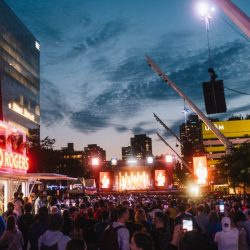
For an inclusive festive city: Article published on the Entretiens Jacques Cartier study day held in Lyon

Professor Jean-Pierre Chupin and student Laurène Smith presented UdeM’s research on the concept of inclusion in festive activities at the Entretiens Jacques Cartier conference in Lyon.

“Montreal and Lyon are both known as festive cities, hosting multiple events each year. But not everyone has the right to celebrate. “Festivals are places of contradiction. They are celebrations that are supposed to be open to everyone, yet they exclude people,” says Laurène Smith, a master’s student in architecture under the supervision of Professor Jean-Pierre Chupin at the University of Montreal.

In an attempt to answer the question “Is the festive city inclusive?” and to discuss their research, these representatives from the UdeM School of Architecture participated in the Entretiens Jacques Cartier 2025, which took place this year in Lyon from October 6 to 8. “Last year, I organized a series of round tables on universal accessibility awareness for the Entretiens. As a continuation of this reflection, the organization Cité anthropocène suggested that we look at the festive city,” summarizes the professor, who works on the issue of inclusion in the organization of cities…”

Read more on the UdeMNouvelles website.

This event, dedicated to festive cities and their mechanisms of inclusion or exclusion, was also documented by the Cité Antropocène and McGill’s Night-time Design Research Group. These resources provide further insights from the collaborating institutions: 

Photo by Getty. 

Join the online public debate on quality in Canada!

Six one-hour sessions from November 3 to 21 (12:15 p.m. ET) (GMT-4)


Topics:

1 – Redefining quality in a partnership approach (Nov. 3)

2 – Advancing spatial justice (Nov. 7)

3 – Building more integrated resilience (Nov. 11)

4 – Accelerating inclusive design (Nov. 13)

5 – Transforming processes and policies (Nov. 19)

6 – Promoting urban health (Nov. 21)


It is with great pleasure that we invite the public to join the Public Forum on Quality organized by the SSHRC Partnership on Quality.  In November, no less than 6 one-hour sessions will stimulate cross-site thematic clusters addressed to Canadians and beyond.

Research sites have been asked to select their most impactful proposed national action to raise the bar on quality. But they will only get 3 minutes to present their proposal in a pitch designed to convince you, the public, of its urgency, modalities and seeked impact.

For each session, Canadian and international invited experts will join members of the steering committee to share comments during a maximum of 10 minutes per proposed action. Everything will happen very quickly, and your reactions will be welcome.

For this public forum on Quality, we aim to target the wider public. We invite everyone to join as many of the sessions you find interesting, you do not have to be affiliated to the research project to join this event, the broader public is very much welcome. This event is public and is completely free.


Please register to as many sessions as you can. Registration is free but mandatory to receive the appropriate link.

Follow this link to register: https://forms.office.com/r/q7mJqsyENh[vc_single_image image=”27257″ img_size=”large” style=”vc_box_border” css=””]

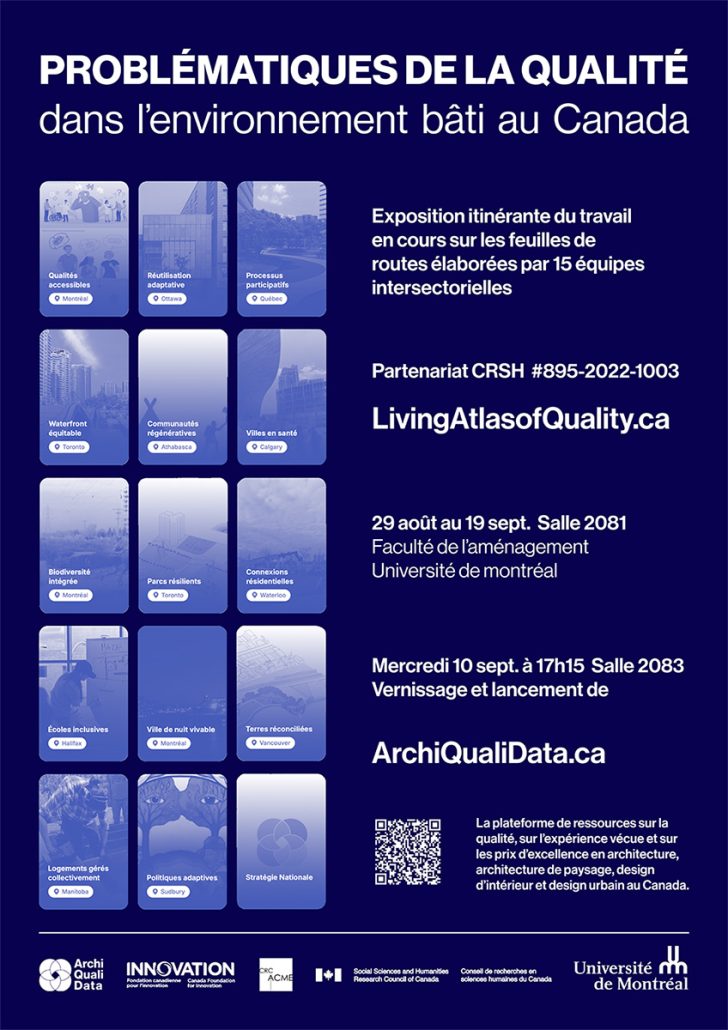
Exhibition: “Quality Issues in Canada’s Built Environment”

As part of a research partnership funded by the Social Sciences and Humanities Research Council of Canada and numerous partners, the Canada Research Chair in Architecture, Competition and Quality at the Université de Montréal, under the direction of Professor Jean-Pierre Chupin, brought together 14 universities and more than 60 academics. Together, they convinced the Rick Hansen Foundation, Public Services and Procurement Canada, the Royal Architectural Institute of Canada, and more than 60 citizen groups, professional organizations, and municipal services to form 15 collaborative research teams, including a team of young Indigenous leaders.

In May 2025, these cross-sector groups presented an initial status report on their roadmaps toward more equitable, sustainable, and socially valuable quality at the annual convention at the University of Toronto and then, in June, at Place Bonaventure during the RAIC’s annual conference.

In Room 2081 of the Faculty of Environmental Design, from August 29 to September 19, 2025, this exhibition of work in progress provides an overview of research undertaken since 2022 and which will continue until 2027. This is an ongoing national project and not a finished product. Videos made by students accompany the panels, which summarize the major issues of quality, the steps taken, and the actions proposed.

A roadmap outlines key elements such as the initial problem, overall objectives, resources, process steps, and proposed short-, medium-, and long-term actions. There are many gray areas in our current definitions of quality: accessible quality, adaptive reuse, participatory processes, resilient parks, inclusive schools, integrated biodiversity, etc. Following a bottom-up process, these stakeholder teams conduct analyses and consultations in specific contexts, addressing issues that challenge current definitions of quality in architecture, landscape, design, and urban planning. The research highlights the importance of collecting lived experiences to break down silos while updating expertise.Don’t miss the launch of the ArchiQualiData.ca platform on September 10 at 5:15 p.m.

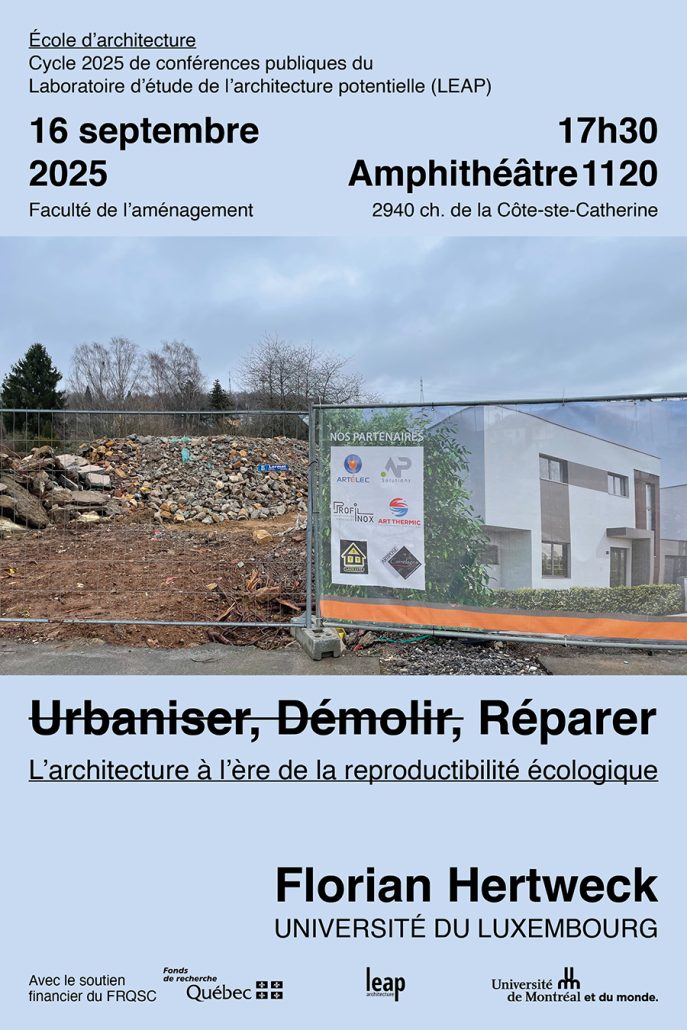
Public conference presented by Florian Hertweck: Urbanize, Demolish, Repair. Architecture in the Age of Ecological Reproducibility

Conference by Florian Hertweck, Université du Luxembourg

Date: Tuesday, September 16th at 5:30 pm.

Location: Amphitheatre 1120, Faculté de l’aménagement, Université de Montréal

Lecture series of the Laboratoire d’étude de l’architecture potentielle


URBANIZE, DEMOLISH, REPAIR

Architecture in the Age of Ecological Reproducibility


Summary:

In the face of climate change and resource scarcity, two practices that have been commonplace in spatial development until now seem obsolete: the expansion of urban areas and the demolition of existing buildings in order to build denser and more modern structures.

Does this spell the end of architecture?

This conference explores how it is still possible to produce architecture under these conditions and on what theoretical basis a socio-ecological architecture can be founded.


Florian Hertweck is a professor of architecture at the University of Luxembourg and co-founder of Less Yellow architecture urbanisme. He has led consortiums of architects, urban planners, and researchers for the Luxembourg in Transition and Greater Geneva Consultation foresight programs. He is a member of the Luxembourg Higher Council for Spatial Planning and the scientific committee of the German Institute for Energy Transition Research (IKEM). Among other projects, he designed the Luxembourg pavilion for the 16th Architecture Biennale and the exhibition The Great Repair at the Akademie der Künste in Berlin and the Pavillon de l’Arsenal in Paris. He is also an organizing member of the European initiative HouseEurope! against demolition and for renovation. Hertweck is the author of numerous publications on the socio-ecological production of space, the most recent of which are The Great Repair. Politics of the Repair Society (Spector Books 2023) and Architecture on Common Ground. Positions and Models on the Question of Land (Lars Müller Publishers 2020).