Date and time: August 25, 2026 from 10:00 am to 12:00 pm.
Held at: Room 1150
Avec Virginie Picon-Lefebvre, professor and researcher at the ENSA Paris Belleville

Canada Research Chair in
Architecture, Competitions and Quality (CRC-ACQUA)
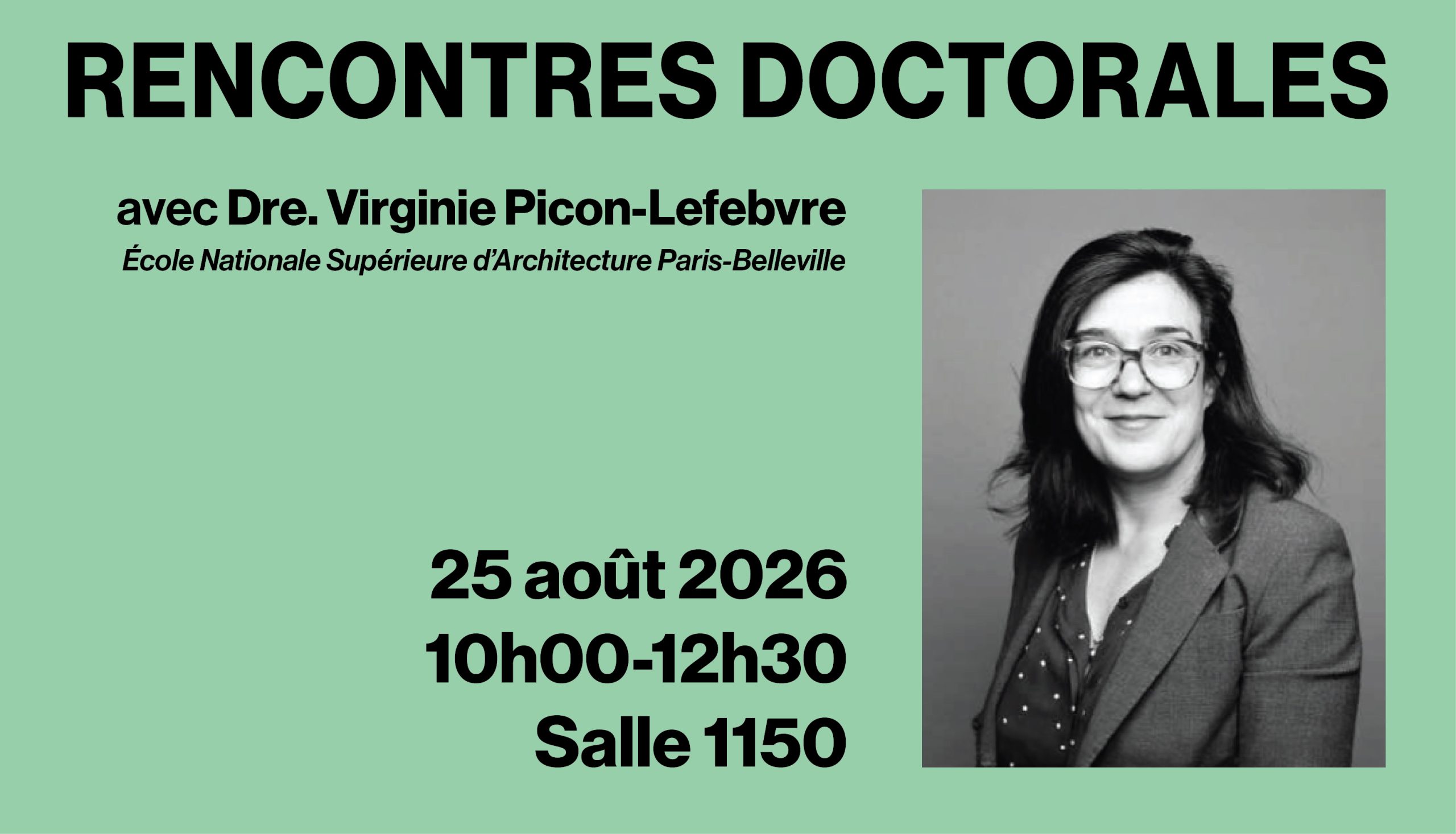
Date and time: August 25, 2026 from 10:00 am to 12:00 pm.
Held at: Room 1150
Avec Virginie Picon-Lefebvre, professor and researcher at the ENSA Paris Belleville

Date and time: August 24, 2026 from 2:00 to 4:15 pm.
Held at: Room 1150
With Antoine Picon, professor of the Histoire of Architecture and Technology, and director of the doctoral programs of the Graduate School of Design de l’Université de Harvard
Date and time: March 18, 2026 from 1:30 to 5:00 pm.
Held at: LEAP, 2064
With Dr. Marie Cecile Kotyk, Assistant Professor, School of Architecture, Planning and Landscape Architecture (SAPL), University of Calgary and member of the Design Justice Research Chair
Presenting PhD Students:
Juliane Alexandre Colmado, étudiante au doctorat individualisé en architecture, Université de Montréal
The Phonotope : shaping sound for a (un-)silenced architecture
Olivia Daigneault Deschênes, étudiante au doctorat individualisé en architecture, Université de Montréal
From Tlachiuak, Montreal (Tiohtià :ke) to Lucha y Siesta, Roma : Architecture as complicit in emancipatory struggles
Yolene Handabaka Ames, étudiante au doctorat individualisé en architecture, Université de Montréal
Between demolition and adaptative reuse : social value as a lever of bottom-up heritage-making
Paloma Castonguay-Rufino, étudiante au doctorat individualisé en architecture, Université Montréal
From post-industrial obsolescence to civic space : reconversion cultures and the architectural reuse of industrial heritage in Canada
Shantanu Biswas Linkon, étudiant au doctorat individualisé en architecture, Université de Montréal
Indexing social value in architecture : comparing community centers and libraries both in Bangladesh and Canada through inclusiveness and spatial justice
Raquel Fernandez, étudiante au doctorat individualisé en architecture, Université de Montréal
Women’s collective housing : a feminist approach to housing
Cyrille Jérôme Tchango Ngamaleu , étudiant au doctorat individualisé en architecture, Université de Montréal
The intention to support care through architecture : a comparative study of the tectonics of the Maggie Centers’ Pavilions
In discussion with :
Dr. Jean-Pierre Chupin, Professor, School of Architecture, Université de Montréal
Canada Research Chair in Architecture, Competitions and Mediations of Excellence
Lecture by Marie Cécile Kotyk, University of Calgary
Date : Wednesday, March 18th at 5.30pm
Location : Université de Montréal, Faculté de l’Aménagement, Amphi 1120
Lecture series of the LEAP and the École d’architecture
From Design Injustice to Design Justice: Why the Built Environment Must Change
Architecture and urban planning have historically produced inequalities, but designing projects from a “spatial justice” perspective makes it possible to envision more equitable, inclusive, and community-oriented built environments.
Design is never neutral. From outright discrimination through urban renewal to hostile architecture and exclusive zoning, the built environment has historically been used to reinforce inequalities in access to housing, safety, mobility, and opportunity. This presentation introduces the concept of “justice through design” as a critical framework for confronting this legacy and transforming the way we plan, design, and govern cities. Historical examples, contemporary case studies, and community initiatives in the areas of housing, public spaces, climate resilience, and education show how design can shift from perpetuating injustice to actively redistributing power. Based on lived experience and participatory practice, the lecture explains why justice in design is not optional, but essential to creating inclusive, equitable, and just communities.
Dr. Marie Cecile Kotyk
Assistant Professor / Design Justice Research Chair
School of Architecture, Planning, and Landscape Architecture (SAPL)
University of Calgary
Marie Cecile Kotyk is an award-winning urban planner, housing professional, and spatial justice researcher with over 15 years of experience promoting equity in the public and nonprofit sectors. As a leading figure in community-based research and spatial justice, her work addresses the systemic forces that produce racial inequalities in the built environment, particularly for Black, Indigenous, and structurally marginalized communities. Her doctoral research led to the creation of the Black Housing Equity Framework, which aims to combat anti-Black racism in housing policy and design. Through her leadership in creating the UDesign Justice initiative at the University of Calgary, Dr. Kotyk is establishing a transdisciplinary center that brings together academics, community members, and practitioners to co-create equity-focused solutions for spatial, social, and systemic transformation.
[vc_row][vc_column]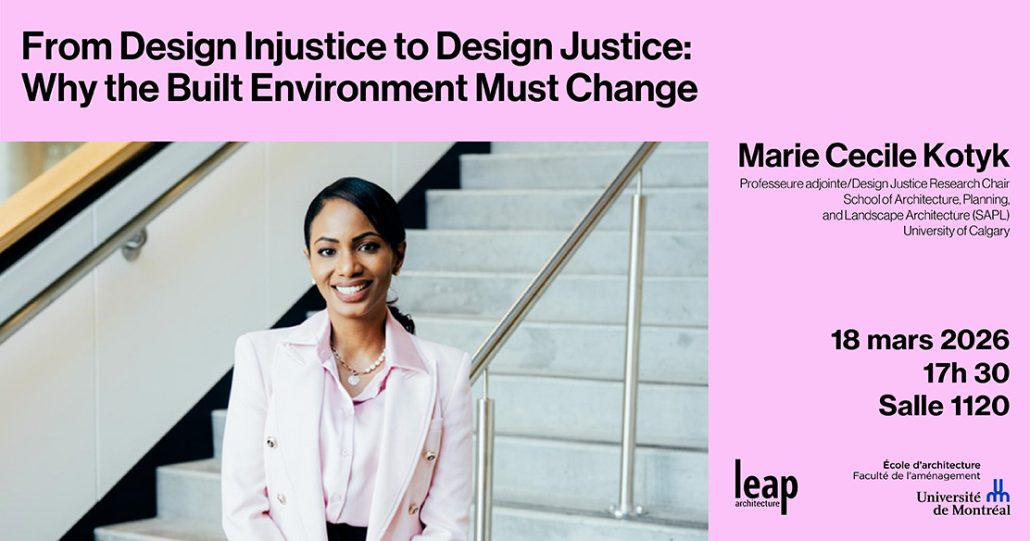
[vc_row][vc_column][mvc_advanced_button btn_text=”DOWNLOAD THE DETAILED PROGRAM IN PDF FORMAT” btn_block=”btn_block” google_fonts=”font_family:Open%20Sans%3A300%2C300italic%2Cregular%2Citalic%2C600%2C600italic%2C700%2C700italic%2C800%2C800italic|font_style:700%20bold%20regular%3A700%3Anormal” caption_url=”” caption_urls=”” caption_urlss=”” btn_url=”url:https%3A%2F%2Fcrc.umontreal.ca%2Fwp-content%2Fuploads%2F2024%2F09%2FProgramme-36-EJC2024_web.pdf|target:_blank” btn_clr=”#ffffff” btn_bg=”rgba(114,114,128,0.77)” btn_hvrclr=”#ffffff” btn_hvrbg=”#727280″ btn_radius=”4″][vc_empty_space][vc_column_text css=””]As part of the Entretiens du Centre Jacques Cartier, an international student workshop (France-Quebec) and three round tables to devise concrete short- and medium-term awareness-raising initiatives in architecture, landscape and design.
Date: Thursday, October 17, 2024, 8:30 am to 6:00 pm
Location: Room 1150, Faculté de l’aménagement, Université de Montréal
Limited seating. Free admission but registration is required: https://www.eventbrite.fr/e/billets-sensibilisation-a-laccessibilite-universelle-dans-les-lieux-publics-1022431519197
This international meeting is organized by the Canada Research Chair in Architecture, Competitions and Mediations of Excellence with special support from the Fond Provencher_Roy et associés HQA+ (High Quality in Architecture and Accessibility).
Description
In contrast to the progress made in raising awareness of the challenges of sustainable development over the past three decades, the delay in understanding the spatial challenges of different forms of disability and special needs is still a major brake on the response of pedagogies, practices and policies.
This project brings together scientific, educational and community expertise, both in the issues and practices of inclusive design, and in digital technologies for raising awareness. This transatlantic collaboration places the issue of inclusive design well upstream. The two-part event consists of an awareness-raising workshop bringing together students from Lyon and Montreal, followed by round-table discussions. The latter will bring together researchers, professionals and political and community players to discuss advances in universal accessibility awareness. We’ll be looking at the potential impact of digital and artificial intelligence technologies in this collective awakening.
Program
8:30 am ― Welcoming participants
9:00 am ― Word of welcome from the Dean of the Faculté de l’aménagement (Université de Montréal)
9:15 am ― Introduction by the project leaders
9:45 am ― ROUND TABLE #1: RAISING AWARENESS OF UNIVERSAL ACCESSIBILITY PRINCIPLES (DIDACTICS OF UNDERSTANDING)
11:45 am ― Students’ summary of the round table
11:55 am ― Lunch
1:00 pm ― ROUND TABLE #2: RAISING AWARENESS OF UNIVERSAL ACCESSIBILITY PRINCIPLES (INTEGRATION INTO PROFESSIONAL PRACTICES)
3:00 pm ― Students’ summary of the round table
3:00 pm ― Break
3:25 pm ― ROUND TABLE #3: RAISING AWARENESS OF UNIVERSAL ACCESSIBILITY PRINCIPLES (POLICIES AND STANDARDIZATION SYSTEMS)
5:25 pm ― Students’ summary of the round table
5:35 pm ― Closing remarks and thanks from the organizers
Date: April 3rd, 2024, 4:00 to 6:00 p.m.
Location: Room 2064, Faculté de l’aménagement, Université de Montréal
Seminar presented by Judith le Maire, professor at the La Cambre Horta Faculty of Architecture at the Université Libre de Bruxelles and director of CLARA – Centre des Laboratoires Associés pour la Recherche en Architecture and the Clara journal, accompanied by Professor Victor Brunfaut.
Description
Visits to architectural archives from the colonial and contemporary periods will help us to understand how they are classified and inventoried. The LEAP and CCA centers visited will enable us to determine and discuss epistemologically the specificities of architectural archiving. The architectural archive is founded on a paradox: the impossibility of archiving buildings on a 1:1 scale necessitates mediation due to their scale, drawings, models, objects with a cryptic status…
The decolonization of archives and the question of their restitution and my research projects imply an ethical and reflexive positioning. This relates to my research object, named by V.Y.Mudimbe “the colonial library”, which brings together all the documents archived by the colonizers in the Congo and brought back to Belgium. Thinking about the archiving of post-colonial or pre-colonial (traditional) architecture, reflecting on its reception, omission or restitution is usefully done by comparison, for example with Canadian institutions at the forefront of these issues. The aim is to submit a PDR in July with colleagues from ULB’s Faculty of Architecture, and then to be able to propose a G3 project.
Our faculty is strongly positioned in the research and doctoral training of students from North Africa, Benin and the Congo. For this reason, their research training and management requires reflection that goes well beyond Belgian borders, and indicates this research in innovative institutions on these subjects.
I’m looking for traces of traditional Congolese architecture, a vernacular architecture that has been depreciated to the point where it is today unknown, unstudied and unhistoriographed. Where, for example, is Kongo architecture to be found in the archives of Belgian explorers in the Congo? Prince Albert of Belgium, for example, stayed in the Congo and made virtually no mention of the traditional buildings or villages he visited. His archives and the archives of the Belgian state nevertheless contain numerous traces and representations of traditional Congolese architecture from the early 20th century.
On February 15, 2020, Jean-Pierre Chupin and David Theodore participated in a discussion about the book “Canadian Modern Architecture” on the occasion of its launch at the Shaughnessy House of the Canadian Centre for Architecture (at 3:00 pm). This reference book is edited by Elsa Lam and Graham Livesey, with a preface by Kenneth Frampton. It examines how the practice of architecture has changed in Canada and how Canadian architects have interpreted international, regional and Aboriginal architectural trends, with a focus on Toronto, Montreal and Vancouver. The conversation focused on Canadian competition and commissioning cultures in an international context.
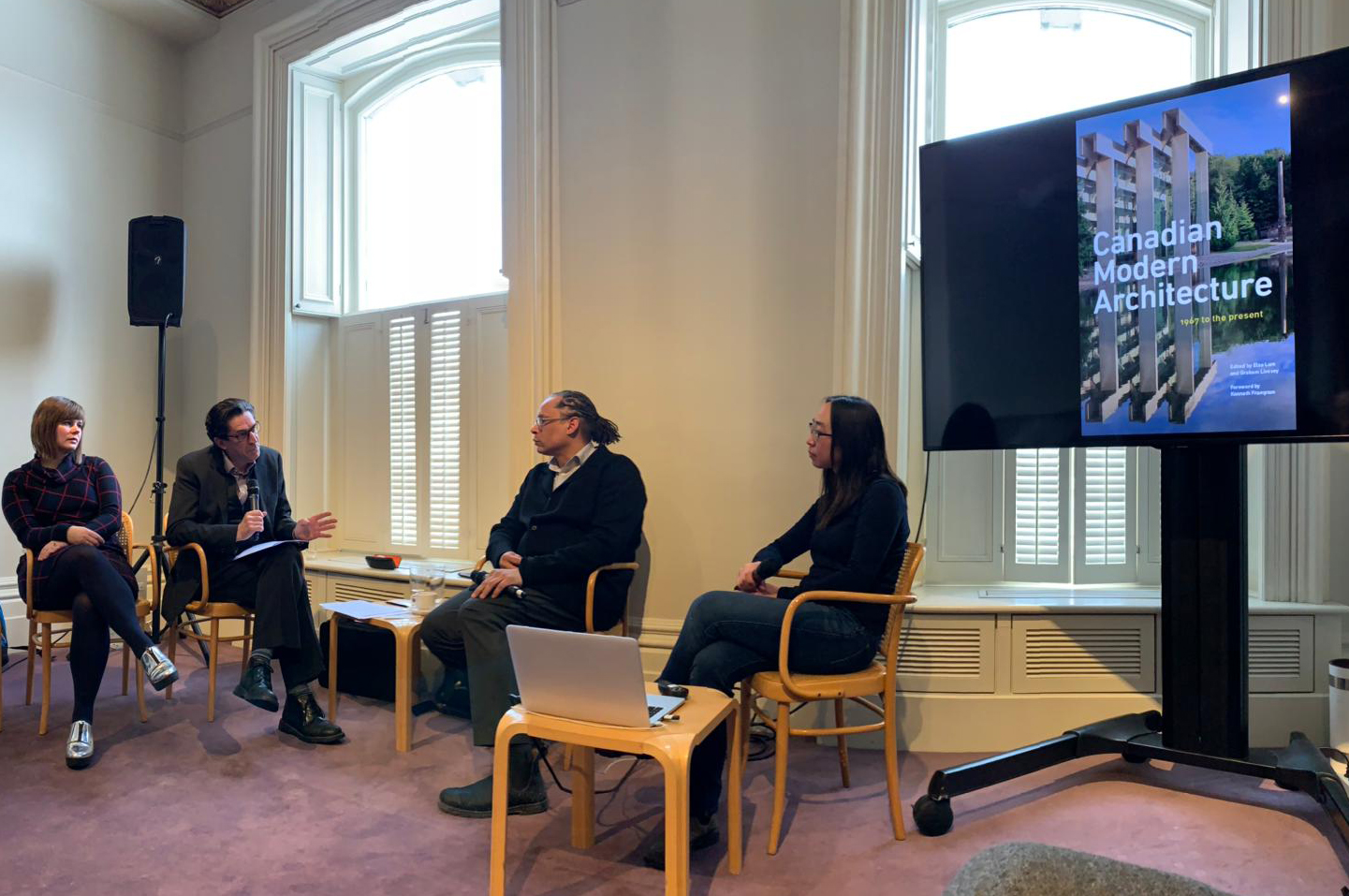
Viveca Pattison Robichaud, Jean-Pierre Chupin, David Theodore, Elsa Lam (Photo. Mandana Bafghinia, 2020)