International Seminar on the Role of Competitions in Quality Policies (2021/01/12 and 19)

In January 2021, these public activities are organized by Jean-Pierre Chupin, jointly with Tina Gregoric and Thomas Amann of the Vienna University of Technology in Austria (TU Wien) with the participation of LEAP researchers Carmela Cucuzzella (Concordia) and Bechara Helal (Université de Montréal).

Presented under the title Policies and Qualities, the two meetings will bring together several specialists of architectural projects developed in the framework of competitions.

Tuesday, January 12, 6 to 8 pm CET (12 to 2 pm in Montreal)

Competitions as political devices for cities

Speakers : Georg Pendl, Carmela Cucuzzella, Typhaine Moogin, Astrid Staufer.

Moderators: Jean-Pierre, Tina Gregoric

Tuesday, January 19, 6 to 8 p.m. CET (12 to 2 p.m. in Montreal)

Competitions as laboratories for innovation

Speakers : Bechara Helal, Wilfried Kühn, Benjamin Hossbach, Lili Pschill & Ali Seghatoleslami.

Moderators: Jean-Pierre, Thomas Amann

Live streaming link: https://www.youtube.com/gbltuwien

Details

Study Day @UQÀM Design Center (2021/12/03): Between experimentation and standardization: Architects and engineers in search of solutions

Date: Friday, December 3, 2021

Location: UQÀM Design Center. The event was sold out in ‘face-to-face’ format, but it was also possible to attend it via Zoom (a registration was required).

Organization: Bechara Helal, Professor of Architecture at the Université de Montréal

The event’s details are available on this link.

This study day was presented in the context of the exhibition Pier Luigi Nervi master designer-builder which continues until February 6, 2022.


THE PROGRAM OF THE DAY:

9:00 a.m.: Welcome

9:30 a.m.: “Building correctly”: Pier Luigi Nervi and the intersecting dynamics of design and research in construction

  • Bechara Helal, Professor, School of Architecture, Université de Montréal

10:30 a.m.: Structures and models: real and virtual explorations and investigations of unconventional building systems

  • Thibaut Lefort, structural engineer and partner, Latéral Inc.

11:30 a.m.: How to move in the field of constructible today in architecture? or The hybridization of knowledge and professions

  • Jean-Marc Weill, architect and engineer, director of the engineering and architecture firm Construction & Environnement, professor at ENSA Paris-Est, Université Gustave Eiffel

12:30 pm.: Lunch break

2:00 p.m.: Roundtable on the cross-practices of research and design in architecture and engineering moderated by Bechara Helal, professor, School of Architecture, University of Montreal

  • Valérie Chartrand, structural engineer, NCK – Nicolet Chartrand Knoll Inc.
  • Martin Houle, architect, partner and project manager, ELEMA experts-conseils
  • Thibaut Lefort, structural engineer and partner, Latéral Inc.
  • Jean-Marc Weill, architect and engineer, director of the engineering and architecture firm Construction & Environnement, professor at ENSA Paris-Est, Université Gustave Eiffel

LEAP and CRC-ACME Study Day @UdeM (2023/08/29): What is the use of the model in architecture?

Date: August 29th, 2023, 8:30am. to 5:30pm.

Location: Room 1150, Faculté de l’aménagement de l’Université de Montréal.

Organization: Denis Bilodeau and Virginie LaSalle

The LEAP study day, which poses the question What is the use of the model in architecture? is intended as an initial exploration of the theme and its potential from multiple perspectives. Speakers are invited to present their reflections and research in the form of short talks (15 minutes) on specific situations or cases involving the use of models in different contexts – professional, artistic, educational or other. The aim of this study day is to open up a multidisciplinary field of investigation into a common practice whose cognitive, cultural and communicative dimensions have yet to be elucidated. Three round-table discussions, each lasting 1.5 hours, will address the day’s title question through a series of intersecting general themes.

Program of the day:

8:30-9:00 Arrival and installation

9:00-10:30 Table 1: SIMULATE AND LEARN
• Bechara Helal
• Anne Cormier and Paloma Castonguay-Rufino
• Maurilio Lima Lobato
• Izabel Amaral
Respondent during the discussion: Lucie Palombi

11:00-12:30 Table 2: TRANSMITTING AND DIALOGUING
• Georges Adamczyk
• Ipek Tureli
• Virginie LaSalle and Victorian Thibault-Malo
• Morteza Hazbei and Carmela Cucuzzella
Respondent during the discussion: Maurilio Lima Lobato

12:30-2:00 Lunch break

2:00-3:30 Table 3: THINK AND UNDERSTAND
• Denis Bilodeau
• Aurelien Catros
• Jean-Pierre Chupin and Joelle Tétreault
• Louis Martin
Respondent during the discussion: Paloma Castonguay-Rufino

4:00-5:30 Open discussion (participants and audience)

3 LEAP seminars on new elementary schools in Quebec, virtual seminars (2021/01-2021/02)

[vc_row][vc_column]
[vc_column_text]
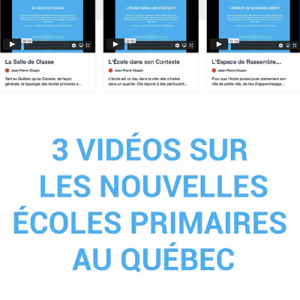
On the themes of the classroom, the gathering space and the relationship to the context, 3 videos from the CRC-ACME put into debate teams from the 5 competitions organized by LabÉcole for new elementary schools in Quebec. Produced by the Canada Research Chair in Architecture, Competitions and Mediations of Excellence, this set of 3 videos presents excerpts from 3 roundtables recorded in January and February 2021 with design teams of the projects submitted to the 5 competitions organized by Lab-École. These winning projects, finalists or submitted in the first phase of the competitions for the sites of Saguenay, Shefford, Maskinongé, Rimouski and Gatineau in 2020 were presented in the exhibition Devoirs d’architecture at the Centre de design de l’UQAM from September 2020 to February 2021. The pandemic did not allow the general public to discover these 160 projects for new elementary school in Quebec. These debates allow us to take the measure of the richness of the proposals.   1 – The round table on the theme of The Classroom and Collaborative Spaces presents different physical and spatial devices imagined by Quebec architects to rethink spaces dedicated to teaching and learning. – Panelists : Étienne Bernier, Christian Bisson, Jean-Pierre Chupin, Andréanne Dumont, Jérôme Duval, Bechara Helal, Sergio Morales, Alexandra Paré, Hubert Pelletier, Nathaniel Proulx Joannisse – Special thanks to Bechara Helal – Organization: Jean-Pierre Chupin and Alexandra Paré – Video editing : Julien Bouthillier – The organizers thank the three main partners of the exhibition: Lab-École, Centre de design de l’UQAM, Laboratoire d’étude de l’architecture potentielle 2021 – Canada Research Chair in Architecture, Competitions and Mediations of Excellence (www.crc.umontreal.ca) 2 – The round table on the theme of The Gathering Space presents a few variations and the dilemmas faced by the design teams become evident. Between spaces dedicated to very specific activities and “all-purpose spaces”, architects must harmonize proposals. The versatility of spatial devices has its qualities, but it can quickly demonstrate its limitations. – Panelists: Randy Cohen, Katarina Cernacek, Jean-Pierre Chupin, Virginie LaSalle, Marie-Hélène Nollet, Alexandra Paré, Charles Laurence Proulx, Geneviève Riopel – Special thanks to Virginie LaSalle – Organization: Jean-Pierre Chupin and Alexandra Paré – Video editing : Julien Bouthillier – The organizers thank the three main partners of the exhibition: Lab-École, Centre de design de l’UQAM, Laboratoire d’étude de l’architecture potentielle 2021 – Canada Research Chair in Architecture, Competitions and Mediations of Excellence (www.crc.umontreal.ca) 3 – The roundtable on the theme of The School and its Context shows that a standard cannot satisfy the complexity and richness of a given site, and even more so that architectural programs need to be always adapted to their context. – Panelists: Philippe Ashby, Martin Brière, Jean-Pierre Chupin, Thomas-Bernard Kenniff, Guillaume Marcoux, Catherine Milanese, Lucie Paquet, Jessy Paquet-Methot, Alexandra Paré – Organization: Jean-Pierre Chupin and Alexandra Paré – Video editing : Julien Bouthillier – Special thanks to Thomas-Bernard Kenniff – The organizers thank the three main partners of the exhibition: Lab-École, Centre de design de l’UQAM, Laboratoire d’étude de l’architecture potentielle 2021 – Canada Research Chair in Architecture, Competitions and Mediations of Excellence (www.crc.umontreal.ca)   TO ACCESS THE 3 VIDEOS: https://vimeo.com/showcase/7619270

LEAP Seminar (2022/04/05): Post-Covid Architecture (A Latourian Perspective)

[vc_row][vc_column]
[vc_column_text]Date: April 5, 2022 at 5:45 PM Location: Amphitheatre 3110, Faculté de l’aménagement, Université de Montréal   This conference about post-pandemic architecture was held by Albena Yaneva, Professor of Architectural Theory at the University of Manchester and Director of the Manchester Architecture Research Group [MARG].   The COVID-19 pandemic has raised new questions about the interrelationships between architecture, science and society – questions that remained latent in professional practice. Based on a ‘remote ethnography’ experiment and a questionnaire sent to 130 architectural practices worldwide, this conference aims to show the extent of the transformative potential that the crisis has exerted on architects’ practices. This analysis is based on the sociological theory of French philosopher Bruno Latour and provides a redefinition of “agency” and its fluctuations in architectural design in a post-COVID world. The Latourian pragmatic approach allows us to treat human and non-human objects of collective life in a symmetrical way. By re-evaluating the role of techniques, objects and materials in the practices of architects, it allows – by the same token – a new reflection on the social dimension of architecture and the forms of political, social and ethical associations that allow for both urban and planetary living together.   The event was organized by the Canada Research Chair in Competitive Architecture and Mediations of Excellence (CRC-ACME) and the inter-university team of the Laboratoire d’étude de l’architecture potentielle (LEAP)   If you wish to learn more about Albena Yaneva, feel free to consult her recent and upcoming publications. Recent books : The New Architecture of Science: Learning from Graphene. Singapore: World Scientific Crafting History: Archiving and the Quest for Architectural Legacy, Ithaca and London: Cornell University Press. Forthcoming: Latour for Architects (Thinkers for Architects), London: Routledge. Architecture after Covid, London: Bloomsbury Publishing.   Presentation by : Jean-Pierre Chupin, CRC-ACME Full Professor, Coordinator of the Laboratory for the Study of Potential Architecture. Information: jean-pierre.chupin@umontreal.ca

LEAP Weekly Graduate Seminar @Next Generation Cities Institute (2022/04/06) : IDEAS-BE

[vc_row][vc_column]
[vc_column_text]
This seminar will be held by Albena Yaneva, Professor of Architectural Theory at the University of Manchester and Director of the Manchester Architecture Research Group [MARG]. Date and time: April 6, 2022 from 2:30 to 6:00 pm. Held at: Next Generation Cities Institute, 2155 Rue Guy, 14th floor, Montreal, Quebec. Presenting PhD Students and Candidates:  Morteza Hazbei, PhD student, INDI Program, Concordia University Measuring the unmeasurable: A proposal for parameterizing urban and architectural qualities. Aristofanis Soulikias, PhD student, INDI Program, Concordia University A Touch of Place: Feeling and expressing the city through handmade film animation. Fatemeh Mehrzad, PhD student, INDI Program, Concordia University Social media as a means of exchange to influence, collect and enable social values for urban regeneration. Moh Abdolreza, PhD student, INDI Program, Concordia University Where is Homeless? When is Homeless? Time-space analysis of OECD definitions of Homelessness. Aurélien Catros, PhD candidate in architecture, Université de Montréal Thinking through models: The phenomenon of projection in architectural design processes. Lucie Palombi, Ph.D. candidate in architecture, Université de Montréal L’architecte en concours, un écrivain ou un écrivant ? In discussion with : Dr. Jean-Pierre Chupin, Professor, School of Architecture, Université de Montréal Canada Research Chair in Architecture, Competitions and Mediations of Excellence Dr. Carmela Cucuzzella, Professor, Design and Digital Arts, Concordia University Concordia University Research Chair in Integrated Design and Sustainability for the Built Environment (IDEAS-BE), Co-Director and Founder, Next Generation Cities Institute (NCGI) Event organized by:  Concordia University Research Chair in Integrated Design Ecology and Sustainability for the Built Environment (IDEAS-BE).

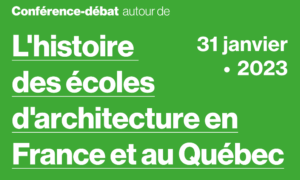
LEAP Seminar @UdeM (2023/01/31): Seminar-debate on the history of architecture schools in France and Quebec

[vc_row][vc_column]
[vc_column_text]
Date: January 31, 2023, 5:30 pm. Location: Amphitheatre 1120, Faculté de l’aménagement, Université de Montréal. On the occasion of the publication in 2022 of L’architecture en ses écoles, une encyclopédie, we welcome Daniel Le Couédic, architect and historian, professor at the University of Western Brittany, and co-director of the book. Around Lucie K. Morisset, professor at UQAM and holder of the Canada Research Chair in Urban Heritage, this conference-debate will also bring together two Quebec contributors to the encyclopedia, François Giraldeau, honorary professor at UQAM’s School of Design, and Jean-Pierre Chupin, professor at UdeM’s School of Architecture and holder of the Canada Research Chair in Architecture, Competitions and Mediation of Excellence,
  • Anne-Marie Châtelet, Amandine Diener, Marie-Jeanne Dumont and Daniel Le Couédic, (under the direction of), L’architecture en ses écoles (une encyclopédie de l’enseignement de l’architecture au XXe siècle), Châteaulin, Éditions Locus Solus, 2022.
  • Jean-Pierre Chupin and François Giraldeau, article Québec, relations et échanges. p. 568.
Summary With its 704 pages and 341 notes written by 147 authors, this work is the result of a vast collective effort to gather and deepen, in an unprecedented way, a state of knowledge that was fragmentary until now. This history of architectural education in France in the twentieth century addresses multiple dimensions – pedagogical, professional, territorial, political, institutional and material – and covers a range of institutions involved in architectural education, such as engineering schools. In France, the history of architectural education was long reduced to its alleged shortcomings and to the story of the struggle of the champions of modernity against the École des Beaux-Arts in Paris. The earthquake of 1968 buried even the memory of that bygone era. The revival came from the United States, where the École had once enjoyed great prestige, but at first it concerned only the nineteenth century. It was not until the 1980s that the complexity of the things debated and experienced in the twentieth century began to be illuminated and, above all, that the investigations of architecture, its teaching, the profession and its practice were correlated. In this movement, one rediscovered the long exacerbated debate between the architects defending the Parisian monopoly and their provincial colleagues, which had preluded the creation of the first regional schools in 1903. The Regional School of Rennes – which became the Regional School of Brittany in 1984 – was the second to open its doors; its history thus allows us to understand all the stages of this bumpy path which, well beyond architecture, provides information on the reinvention of higher education in France and on the role it played in the structuring of the national territory. The discussion will also be based on another book by our guest: Le Couédic Daniel, Sauvage André, L’École d’architecture de Bretagne : Un siècle de fabrique des architectes, Châteaulin, Locus Solus, 2022.

LEAP Seminar (2023/03/16): Material Cultures through the filter of the Cecobois and Woodworks Awards

[vc_row][vc_column]
[vc_column_text]
A seminar presented by Izabel Amaral (UdeM) around a SSHRC Insight Development Grant: (in collaboration with Carmela Cucuzzella (Concordia) and Jean-Pierre Chupin (UdeM) An Ecology of Wood Cultures in Canada (20032020): comparing constructive cultures through awarded architectural designs At the  intersection of  architectural theory and  cultural studies, this  research investigates wood  architecture as a symbolic universe that allows us to study the presence of nature in human culture. This research will theorize the diversity of expressions of quality in Canadian architecture, from the standpoint of environmental preoccupation, building culture and architectural expression. Considering wood architecture as a form of “cultural ecology”, it has the potential to reveal how Canadian cultures represent and symbolize their relations to the land and natural resources, as well as the cultures of its founding peoples. Notwithstanding the interest in wood as a major alternative to fossil fuelbased construction materials, this research will highlight the symbolic spectrum of wood buildings, which ranges from local and indigenous traditions to ecological aesthetics, representing forms of making that rely both on traditional architectural practice or recent building technologies and computeraided design. We aim to better interpret and understand how advancements in architectural practice and building techniques affect the way architecture is envisioned and materialized in Canada during the past decades. In parallel to studying the influence of environmental considerations to  architectural forms in  Canada, we  will make sense of  a  dissonance within the theory of architecture between ideas about the interdependency or autonomy of architectural form (visual appearance), material (what it is made of) and meaning (messages and ideals expressed).

LEAP Seminar @UdeM and CRC-ACME(2019/11/27): Publishing in Open Access with Vincent Larivière (Scientific Director of the Érudit Platform)

Open access publications are becoming standardized and it is important for researchers, young and experienced, to become familiar with practices, platforms (scholar or other) and especially the main issues of “open access” (rights, etc.). ).

International expert on these complex issues, Professor Vincent Larivière has kindly agreed to meet LEAP researchers on Wednesday 27 November from 17:30 to 19:15.

Vincent Larivière is a tenured professor at the School of Library and Information Science at the Université de Montréal, where he teaches research methods in the field of information sciences and bibliometrics.

He is also Scientific Director of the Érudit platform, Deputy Scientific Director of the Observatory of Science and Technology and a regular member of the Interuniversity Center for Research on Science and Technology.

He holds a Bachelor’s degree in Science, Technology and Society (UQAM), a Master’s degree in History of Science (UQAM) and a Ph.D. in Information Science (McGill), and also completed a postdoctoral fellowship Department of Information and Librarianship, Indiana University.

LEAP annual seminar and international symposium (+LéaV) : Lieux et rituels de l’utopie et de la dystopie (Architecture de la catastrophe)

Colloque international fruit d’une collaboration entre le LEAP (Montréal) et le LéaV (Versailles). Du mardi 14 mai à 16h00 au jeudi 16 mai à 16h00 dans la salle 1150 du pavillon de la Faculté de l’aménagement. Pour tous renseignements contacter le professeur Jean-Pierre Chupin : jean-pierre.chupin@umontreal.ca

Entrée libre sur inscription à leap.labo@gmail.com


PROGRAMME : 

Mardi 14 mai (Conférence et débat d’ouverture)

16h00 – Mot de monsieur Raphaël Fischler, doyen de la Faculté de l’aménagement de l’UdeM

16h10 – Présentations du colloque international par Jean-Pierre Chupin (LEAP@UdeM)

16h30 – Paolo Amaldi (LéaV) et Carmela Cucuzzella (LEAP@Concordia) / Résumé de la rencontre du 19 et 20 octobre 2018 à l’ENSA de Versailles

17h00 – Annalisa Viati Navone (LéaV) De l’unité d’urgence à la villa au bord de la mer :  La destruction imaginée par Marco Zanuso

17h30 – Conférence d’ouverture : Philippe Potié (LéaV) /  L’architecture ou les lendemains de l’Apocalypse

18h30 – Cocktail de bienvenue


Mercredi 15 mai

8h30 – Accueil des participants

9h00 – Anne Cormier (LEAP@UdeM) + Alexandra Paré (Doctorante@UdeM) /Aldo van Eyck : Jouer sur les lieux de la catastrophe

9h30 – Georges Adamczyk (LEAP@UdeM) + Sherif Goubran (Doctorant@Concordia) / Utopia at Home : Mary Otis Stevens and Thomas Mc Nulty’s Lincoln House

10h00 – Suzanne Stacher (LéaV) / Les successeurs de la Tour de Babel, Architectures en forme de spirale face à la crise

10h30 – Pause-café

11h00 – Alessandra Mariani (Doctorante@UQÀM) / Communiquer l’utopie en brouillant l’atmosphère : le Blur Building de Diller + Scofidio

11h30 – Isabella Pasqualini (LéaV) /  Weltuntergang : L’inquiétante étrangeté des “incantations créatrices” chez les artistes invoquant la destruction de l’existant et la création d’un monde fantastique

12h00 – Période de débat

12h30 – Pause lunch

14h30 – Carmela Cucuzzella (LEAP@Concordia) + Arisotofanis Souliakis (Doctorant@Concordia) / Cinematographic Representations of Detroit between no-place and the-place

15h00 – Alfonso Pinto (ENS Lyon) / Imaginaires cinématographiques de l’épidémie : L’urbain aux temps des pestilences

15h30 – Emanuel Licha (Études cinématograpiques@UdeM) / Représenter les conflits : l’ ”hôtelisation” du regard

16h00 – Pause-café + projections cinématographiques

16h30 – David Malaud + Maud Nys (Doctorants LéaV) / Cedric Price. Du travail au jeu : une utopie de l’impermanence

17h00 – Tiphaine Abenia (ENSA Toulouse) /Utopie réalisée cherche opportunités de réactualisation : Le cas de la Ökohaus (Frei Otto, 1987, Berlin)

17h30 – Regards et commentaires sur la journée par Denis Bilodeau (LEAP@UdeM)


Jeudi 16 mai 2019

8h30 – Accueil des participants

9h00 – Pierre Boudon (LEAP@UdeM) + Lucie Palombi (Doctorante@UdeM) / La traversée du paysage : Punta Pite, Chili

9h30 – Jean-Pierre Chupin (LEAP@UdeM) + Aurélien Catros (Doctorant@UdeM) / Burning Man (Black Rock City) : consumer ou consommer l’hétérotopie ?

10h00 – Louise Pelletier (LEAP@UQÀM) + Anne Sabourin (Doctorante@UQÀM) / L’utopie et la dystopie architecturale dans l’oeuvre de Michel Houellebecq et J.G. Ballard

10h30 – Pause-café

11h00 – Mathilde Lavenu (ENSA Clermont-Ferrand) / L’architecture des “inorganisés” : les mille clubs, témoins édifiés d’une utopie ?

11h30 – Cynthia Hammond (LEAP@Concordia) + Alex Tigchelaar (Doctorant@Concordia) / The ‘Red Light’ District of Montréal and the Spatial Politics of Sex Work

12h00 – Période de débat

12h30 – Pause lunch (+ Rencontre de coordination des chercheurs du LEAP)

14h00 – Bechara Helal (UdeM) + Morteza Hazbei (Doctorant@Concordia) / Les machines à utopies : Modèles et instruments du laboratoire architectural

14h30 – Brent Patterson (Doctorant EHESS Paris) / Subjectivités et représentations complexes : volonté politique et l’esprit de l’utopie pendant une catastrophe. Le cas du siège de Sarajevo.

15h00 – Paolo Amaldi (LéaV) / Cata-strophe et architecture : Pensée abstraite VS figure de l’errance

15h30 – Pause-café

16h00 – Regards et commentaires sur la journée par Stephan Kowal (UdeM)

16h30 – Discussion ouverte et clôture de la rencontre par les organisateurs