How can we mobilize students, professionals and public authorities around the challenges of universal accessibility in public spaces?

As part of the Entretiens du Centre Jacques Cartier, an international student workshop (France-Quebec) and three round tables to devise concrete short- and medium-term awareness-raising initiatives in architecture, landscape and design.

Date: Thursday, October 17, 2024, 8:30 am to 6:00 pm

Location: Room 1150, Faculté de l’aménagement, Université de Montréal

Limited seating. Free admission but registration is required: https://www.eventbrite.fr/e/billets-sensibilisation-a-laccessibilite-universelle-dans-les-lieux-publics-1022431519197

This international meeting is organized by the Canada Research Chair in Architecture, Competitions and Mediations of Excellence with special support from the Fond Provencher_Roy et associés HQA+ (High Quality in Architecture and Accessibility).


Description

In contrast to the progress made in raising awareness of the challenges of sustainable development over the past three decades, the delay in understanding the spatial challenges of different forms of disability and special needs is still a major brake on the response of pedagogies, practices and policies.

This project brings together scientific, educational and community expertise, both in the issues and practices of inclusive design, and in digital technologies for raising awareness. This transatlantic collaboration places the issue of inclusive design well upstream. The two-part event consists of an awareness-raising workshop bringing together students from Lyon and Montreal, followed by round-table discussions. The latter will bring together researchers, professionals and political and community players to discuss advances in universal accessibility awareness. We’ll be looking at the potential impact of digital and artificial intelligence technologies in this collective awakening.


Program

8:30 am ― Welcoming participants

9:00 am ― Word of welcome from the Dean of the Faculté de l’aménagement (Université de Montréal)

  • Carmela Cucuzzella, doyenne, Université de Montréal Aménagement

9:15 am ― Introduction by the project leaders

  • Jean-Pierre Chupin, Chaire de recherche du Canada en architecture, concours et médiations de l’excellence, Université de Montréal Architecture

  • Olivia Rousseaux, Architecte-Ingénieure, AIA Lyon Life designers

9:45 am ― ROUND TABLE #1: RAISING AWARENESS OF UNIVERSAL ACCESSIBILITY PRINCIPLES (DIDACTICS OF UNDERSTANDING)

  • Joelle Forest, Maîtresse de Conférences, Chargée de mission Innovation et Créativité, INSA Lyon
  • Virginie LaSalle, Professeure adjointe, Université de Montréal Design
  • Sarah Huxley, Responsable recherche et développement, Fondation Véro et Louis
  • Xavier Arnaud, Maître de conférences, ENSA de Lyon
  • Agathe Barbery, Etudiante en Master 2 Architecture, ENSA de Lyon
  • Clément Petiteau, Etudiant en 5ème année, INSA de Lyon
  • Cléo Lethier, Etudiante Bachelor 3 Architecture, Université de Montréal Architecture
  • Sandrine Bovet, Etudiante en Maîtrise 2 Architecture, Université de Montréal Architecture

11:45 am ― Students’ summary of the round table

11:55 am ― Lunch

1:00 pm ― ROUND TABLE #2: RAISING AWARENESS OF UNIVERSAL ACCESSIBILITY PRINCIPLES (INTEGRATION INTO PROFESSIONAL PRACTICES)

  • Olivia Rousseaux, Architecte-Ingénieure, AIA Lyon Life designers
  • Sonia Gagné, Architecte principale, Provencher Roy et associés
  • Julie Leclair, Conseillère en planification, Direction des Bibliothèques, Ville de Montréal
  • Isabelle Cardinal, directrice services de consultation, Société logique design universel
  • Elisabeth Labarre, Etudiante en Maîtrise 2 Architecture, Université de Montréal Architecture
  • Simon Ledoux, Etudiant Maîtrise 1 Architecture, Université de Montréal Architecture
  • Marine Giraudon, Architecte Doctorante, ENSA de Lyon
  • Julie Brachet, Etudiante en Master Architecture, ENSA de Lyon

3:00 pm ― Students’ summary of the round table

3:00 pm ― Break

3:25 pm ― ROUND TABLE #3: RAISING AWARENESS OF UNIVERSAL ACCESSIBILITY PRINCIPLES (POLICIES AND STANDARDIZATION SYSTEMS)

  • Katty Taillon, directrice, Fondation Véro et Louis
  • Shin Alexandre Koseki, Professeur agrégé, Chaire UNESCO paysage + MILA
  • Laurence Parent, Conseillère d’arrondissement, Présidente de la Commission sur les transports de Montréal, Vice-présidente de la Société de transport
  • Carmela Cucuzzella, doyenne, Université de Montréal Aménagement
  • Alice Chatelard, Architecte, étudiante en Maîtrise 2 Urbanisme, ENSA de Lyon
  • Alexis Mazurier, Etudiant en 5ème année, INSA de Lyon
  • Sarah Bronsard, Doctorante Géographie et Aménagement, Université Lyon 2
  • Tchango Ngamaleu, Architecte Doctorant, Université de Montréal Architecture
  • Laurene Smith, Etudiante en Maîtrise 1 Architecture, Université de Montréal Architecture

5:25 pm ― Students’ summary of the round table

5:35 pm ― Closing remarks and thanks from the organizers

  • Laurence Parent, Conseillère d’arrondissement, Présidente de la Commission sur les transports de Montréal, Vice-présidente de la Société de transport
  • Jean-Pierre Chupin, Chaire de recherche du Canada en architecture, concours et médiations de l’excellence, Université de Montréal Architecture


A doctoral student in architecture receives prestigious Trudeau Scholarship

Paloma Castonguay-Rufino, an individualized doctoral student in architecture at the Faculty of Environmental Design’s School of Architecture, has been selected as a 2024 Pierre Elliott Trudeau Foundation Scholar. This year, nearly 450 applications were submitted, from some 40 Canadian universities and 60 universities around the world.

Paloma Castonguay-Rufino is an individualized Ph.D. student in architecture at the Université de Montréal. After obtaining a Bachelor’s and Master’s degree in architecture, she completed a professional internship specializing in the conservation of built heritage. Her doctoral research lies at the intersection of environmental, heritage and social considerations. In a reflexive approach, she takes a critical look at the notion of industrial heritage across Canada, through the analysis of contemporary projects that reuse urban industrial remains.

Paloma takes part in collaborative research projects, in particular the SSHRC partnership “Quality in Canada’s Built Environment: Roadmaps to Equity, Social Value and Sustainability” led by the Canada Research Chair in Architecture, Competitions and Mediations of Excellence (CRC-ACME). She has been involved with the next generation of architects, notably through mentoring of student architecture projects, and her volunteer work with Héritage Montréal’s Next Generation Committee, as well as in editorial activities for different architecture and design publications. She is a member of the board of directors of the Association québécoise pour le patrimoine industriel (AQPI).

HALIFAX 2024 Convention Program: First Versions of 14 Roadmaps to Quality

Principles & Objectives of the 3rd annual SSHRC Partnership Convention on Quality

In 2023, we invited all partners and participants to the annual convention of the SSHRC research partnership on Quality hosted by the University of Calgary to report on positive lived experiences in the built environment. It has now become a major feature of the 14 situated projects across Canada to learn the best ways to collect ‘lived experiences’ of quality. This practice aims to raise our understanding of the actual meaning of quality in the everyday life of non-experts. We cannot help but notice that this practice has yet to become common design protocol in most professional milieux. We need to acknowledge this as an output of our collective project after two years of intersectoral exchanges. Lived Experience is about the personal knowledge, perceptions, and feelings within a world within which we live. Our responses reflect these personal and personally significant views, in contrast to researched or more formal descriptions.

In 2024, all partners and participants have been invited to report on one positive output based on their own experience of the project after two years. This will be the subject of the first Café-Workshop at the Halifax Convention:

  • What do you consider to be the main positive outputs of our partnership research on quality?
  • How do you think these two years of work at local and national levels have helped change your understanding and definition of quality in the built environment?

The built environment is a collective project and, even though designers are a crucial component in the overall process, they cannot consider themselves to be the only responsible, hence the sole reference point of a roadmap to quality. This is where the notion of “partnering” becomes critical to raise the bar of quality for all.

What is a “roadmap to quality” at this stage of our research partnership?

One of the main results of our project, which brings together the viewpoints of citizens, cities, professionals and researchers, has always been to produce at least 14 roadmaps toward greater quality in Canada’s built environment. This objective has been inscribed in the very title of the grant proposal from day one, and we have hypothesized that this renewed approach to quality lies at the intersection of equity and sustainability and, as such, this common assumption defines the new social value of built environments.

For Halifax 2024, all 14 teams of partners have been tasked with sharing an initial presentation of their roadmap to raise the bar of quality. Although these are the first outlines, the fact that we have acquired a better understanding of the exemplary situations to be transformed now calls for action-oriented roadmaps rather than simply knowledge-oriented ones.

Each roadmap incorporates its own localized and specific angle of work as starting points toward a form of generalization. Hence, the 14 roadmaps displayed in the exhibition room of the School of Architecture at Dalhousie University are not generic. They embody a series of instructions or “active principles” which are means of reaching a destination.

To move from research to action, we must clarify each of the 14 destinations. These are intimately linked to the problematic qualitative situation that the projects have been exploring for over two years, but the destination may indeed differ from the research question. These goals should be formulated as transformative projects or ventures to trailblaze a path toward higher quality specific to each situation and scale. All teams are still struggling with alternating research for new knowledge and transformative action. The title of a roadmap is not the title of a research project.

The 14 roadmaps are therefore different ways of answering the same question:

How can we raise the level of quality – as quickly as possible – given the diversity of built situations?

This third national in-person convention has been entirely rethought by the Steering Committee as a series of 4 Café-Workshops. These are meant for us to meet, of course, but they are also meant for us to better learn to work together through multiple voices. These workshops are envisioned as spaces in which partners can work together to discuss and answer questions organised around four main themes (outputs, dissemination, roadmaps and national strategy). To enhance the quality of the exchanges, participants are divided in small groups (max. 15) and remain with that same group throughout the 4 Café-workshops. Each of these workshops is mediated by a team of two moderators who ensure that the process is implemented and that participants work on the questions submitted to them. A team of students is in charge of taking notes, recording and reporting on the workshops at the end of each day. We are privileged to welcome a bigger group of students and a new group of young Indigenous partners thanks to the generous support of RAIC+RHF+OAA.

On behalf of the Governance Board and the Steering Committee, I would like to address my warm thanks to the great team of professors and students at Dalhousie Universityfor their generous hospitality. No doubt this convention will be a turning point in our journey!

Jean-Pierre Chupin, PhD, Professor, Architect MOAQ, MIRAC. Holder of the Canada Research Chair in Architecture, Competitions and Mediations of Excellence at Université de Montréal and Principal Investigator of the SSHRC Research Partnership on Quality in Canada’s Built Environment.

Analogical Thinking in Architecture. Connecting Design and Theory in the Built Environment (New York: Bloomsbury Publishing, 2023), a new book by Jean-Pierre Chupin

Description

This book provides an in-depth exploration of the rich and persistent use of analogical thinking in the built environment. Since the turn of the 21st century, “design thinking” has permeated many fields outside of the design disciplines, used whenever disciplinary boundaries need to be transcended in order to think “outside the box”. This book argues that these qualities have long been supported by “analogical thinking”—an agile way of reasoning in which we think the unknown through the familiar.

The book is organized into four case studies: the first reviews analogical models that have been at the heart of design thinking representations from the 1960s to the present day; the second investigates the staying power of biological analogies; the third explores the paradoxical imaginary of “analogous cities” as a means of integrating contemporary architecture with heritage contexts; while the fourth unpacks the critical and theoretical potential of linguistic metaphors and visual comparisons in architectural discourse.

Comparing views on the role of analogies and metaphors by prominent voices in architecture and related disciplines from the 17th century to the present, the book shows how the “analogical world of the project” is revealed as a wide-open field of creative and cognitive interactions. Showing how analogy has the power to reconcile design and theory, it is a must-read for both designers and theorists alike.

Author

Jean-Pierre Chupin is a professor at the Université de Montréal School of Architecture, where he holds the Canada Research Chair in Architecture, Competitions and Mediations of Excellence.

Reviews

Analogical Thinking in Architecture is a careful and timely study of analogy as a powerful tool for connecting design and theory in the built environment. Chupin makes a compelling argument about the potential of analogical thinking to renew the epistemological horizons of architectural theory and to contribute to a better understanding of contemporary design practice. Eloquently written and filled with insightful examples, it is a must-read for every architecture student, design educator and practitioner.

Albena Yaneva, University of Manchester, UK

One of the foremost specialists of analogy, this fundamental dimension of architectural thinking, gives us an expanded English version of his seminal contribution to the study of a topic of interest both to theorists and practitioners. Indeed, analogy is key to the understanding of architectural creativity.

Antoine Picon, Harvard Graduate School of Design, USA

In four chapters, Jean-Pierre Chupin takes us on an intellectual and sensory journey, reviewing key moments in Western architectural theory and history and illuminating modes of thought that remain little explored in the discipline. Analogical Thinking in Architecture is a must-read for scholars and practitioners alike.

Dieter Dietz, EPFL Lausanne, Switzerland

Jean-Pierre Chupin talks to Radio Canada about the Chandigarh principles and the derivatives of the Corbusé utopia

Jean-Pierre Chupin is invited to Radio Canada’s Tout Terrain (Janic Tremblay) to reflect on the current state of affairs and the derivatives of Le Corbusier’s concepts of architecture and the city in Chandigarh, India.

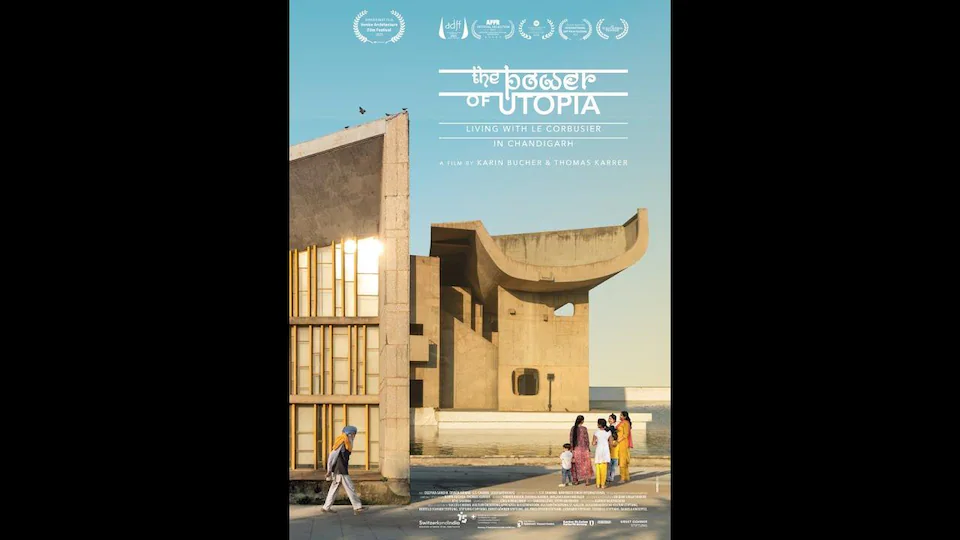
On the occasion of the Festival international du film sur l’art (FIFA) in Montreal, the film The Power of Utopia – Living with Le Corbusier in Chandigarh will be shown. When architect Le Corbusier designed the city of Chandigarh, India, he imagined a city that would enable harmonious interaction between its inhabitants and the environment. For some, this represented progress and success, while for others it was a failure. Janic Tremblay discusses the case of Chandigarh and, more broadly, Le Corbusier’s approach to architecture and urban planning with Jean-Pierre Chupin, Professor at the School of Architecture of the Université de Montréal and holder of the Canada Research Chair in Architecture, Competitions and the Mediations of Excellence.

To listen to the episode on Sunday, March 10, 2024:

https://ici.radio-canada.ca/ohdio/premiere/emissions/tout-terrain/segments/rattrapage/485206/lurbanisme-de-le-corbusier-entrevue-avec-jean-pierre-chupin

How can we collect the diversity of quality lived experiences?

The City of Montreal has selected the Canada Research Chair in Architecture for research into the lived experience of quality by users of public buildings.

Jean-Pierre Chupin, Bechara Helal and Carmela Cucuzzella will develop a protocol for collecting lived experiences with doctoral students: Firdous Nizar, Paloma Castonguay-Rufino, Yolene Handabaka, Shantanu Biswas Linkon, Cyrille Tchango Ngamaleu of the Individualized PhD in Architecture program.

The proposal from the Canada Research Chair in Architecture, Competitions and Mediations of Excellence (CRC-ACME) team was selected in Stream 1 of the call “Developing a Stronger Design Culture Together – Edition 2” (Call for Proposals 2023-2024).

Project: Protocol for study and qualitative assessment of the social value of public buildings through documentation of users’ lived experiences

Description: A protocol for post-occupancy quality assessment, describing methods for gathering and studying accounts of lived experiences in municipal spaces and buildings, and for compilation of a set of remarkable lived-experience stories and records. The goal is to better understand the factors that influence the quality of lived experiences in those spaces and buildings.

This project will enrich the strategies and actions for Sustaining Quality outlined in the Design Montréal Quality Toolkit (Quality Operation section).

It will also contribute to achievement of the results targeted by the Montréal 2030 Strategic Plan, notably as concerns the following priority:

Priority 19 – Provide all Montrealers with safe, quality living environments and a local response to their needs

More information on CRC-ACME: https://crc.umontreal.ca

More information on the Design Montréal program: https://designmontreal.com/en/calls/developing-a-stronger-design-culture-together-2nd-edition?section=3948

Two doctoral students defend their individualized doctorate in architecture (Mandana Bafghinia and Lucie Palombi)

Mandana Bafghinia, a doctoral student in cotutelle between Université de Montréal and Université Lyon 2, under the co-direction of Jean-Pierre Chupin and Manuel Appert, defended her thesis:

The Skyscraper’s Summit, as a Beacon and a Viewing Platform: New York, Paris, Montreal, Shanghai

December 14th, 2023

Thesis directors:

  • Université de Montréal: Professor Jean-Pierre Chupin, Architecture
  • Université Lyon 2: Professors Christian Montes and Manuel Appert, Geography

Jury members:

  • Professor William Straw, External Examiner, McGill University
  • Professor Xiangning Li, Jury Member, Tongji University
  • Izabel Fraga Do Amaral E Silva, President-Rapporteur, Faculté d’aménagement – École d’architecture, Université de Montréal
  • Carmela Cucuzzella, Dean, Faculté d’aménagement, Université de Montréal

https://architecture.umontreal.ca/lecole/nouvelles/nouvelle/news/detail/News/avis-de-soutenance-de-these-de-mandana-bafghinia/


Lucie Palombi, doctoral student under the direction of Jean-Pierre Chupin, defended her thesis:

De la textualité du projet professionnel en situation de concours en architecture: hermeneutique et comparaison de textes liés à des projets lauréats de concours d’architecture au Québec entre 2010 et 2020

January 15th, 2024

Thesis director:

  • Professor Jean-Pierre Chupin, Faculté d’aménagement – École d’architecture, Université de Montréal

Jury members:

  • Pierre Chabard, External Examiner, École nationale supérieure d’architecture de Paris
  • Alice Covatta, Jury Member, Faculté d’aménagement – École d’architecture, Université de Montréal
  • Izabel Fraga Do Amaral E Silva, President, Faculté d’aménagement – École d’architecture, Université de Montréal
  • Michel Max Raynaud, Dean’s Representative, Faculté d’aménagement, Université de Montréal

https://architecture.umontreal.ca/lecole/nouvelles/nouvelle/news/eventDetail/Event/avis-de-soutenance-de-these-de-lucie-palombi-1/

Mapping the impact of rising oceans on high-rise buildings worldwide

Mandana Bafghinia and Jean-Pierre Chupin, assisted by master’s student Conor DeSantis, publish a report funded by the Council of Tall Buildings and Urban Habitats


To discover the maps:

https://storymaps.arcgis.com/stories/5dd6e81456e04204af90a3c209dfd76b


To consult the report:

Bafghinia, M., Chupin, J.-P., Skyscrapers as a Complex Response to Rising Waters: Resilience and Adaptability. Report summarizing the result of the 2019 CTBUH Student Research Project published on the platform of the Council for Tall Buildings and Urban Habitat (2023) https://global.ctbuh.org/resources/papers/4600-Bafghinia_SkyscrapersAsAComplexResponse.pdf

Two Post-Docs Join the Partnership on Quality Coordination Team

Following public consultation and job posting, two postdoctoral researchers have been recruited to assist the SSHRC Quality in the Built Environment (QBE) partnership coordination team.

Maria Patricia Farfan Sopo, a new doctor from McGill University, is funded by the partnership’s SSHRC budget, while Morteza Hazbei, a new doctor from Concordia University, is funded by the complementary budget granted by Université de Montréal to the Canada Research Chair in Architecture, Competitions and Mediations of Excellence.

The biographical summaries below will help you appreciate their remarkable personal and academic careers. Welcome to Maria Patricia and Morteza!


Dr. Maria Patricia Farfan Sopo

My personal, academic and professional background – or how I have come to view and approach the field of the built environment – started with my undergraduate studies in my native Colombia, getting closed to sustainability issues in Latin American regions, and post-graduate experience acquired during my Master (Minimum Cost Housing McGill University) – and Ph.D. in History and Theory (McGill University) completed on February 2023.

In my doctoral work I examine the spatial transformations carried out by Indigenous communities from the Colombian Pacific region who create a pacifist movement through culture recognition in the midst of violence, with special focus on the Women and political force who created the ephemeral built environment as territory-great house. I have held a wide range of academic administrative and leadership positions, while working in conjunction with diverse communities and associations. This has given me a broad perspective of academia and has prepared me to efficiently collaborate with experts from different disciplines and cultures.


Dr. Morteza Hazbei

I earned my PhD from Concordia University in September 2023, focusing on enhancing the sustainability of our built environment through the integration of livability, energy efficiency, and contextual design. This interdisciplinary exploration allowed me to investigate the factors that contribute to the quality of our built environment from both architectural and engineering perspectives.

Concurrently, I served as a lead student researcher in Concordia’s SSHRC partnership project, delving into the interconnectedness of livability, decarbonization, and biodiversity to foster an inclusive and equitable built environment, especially for marginalized demographics like the elderly people. Additionally, my role as Vice President on the SSHRC partnership graduate student committee provided valuable collaborative opportunities with students across diverse disciplines, offering me a comprehensive understanding of the multifaceted nature of built environment quality—perfectly aligning with my research focus.


Source : https://livingatlasofquality.ca/home

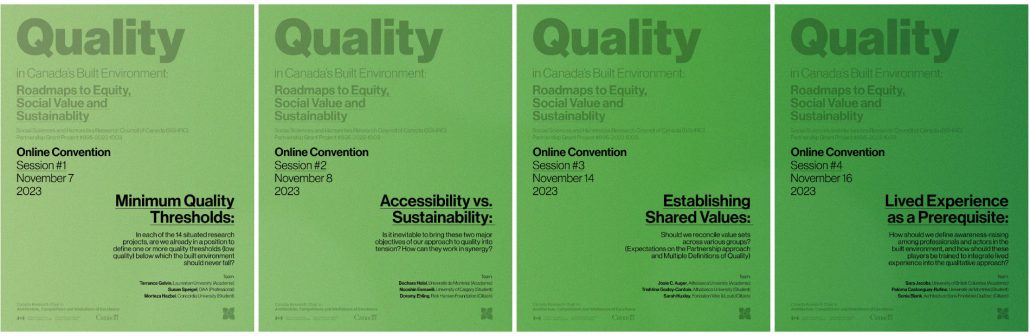
The 4 videos of the 2nd SSHRC Quality Partnership Online Convention are now freely available

Recordings of the 4 sessions of the SSHRC Quality Partnership’s second online convention are now freely available.

The research partnership is entitled Quality in Canada’s Built Environment: Roadmaps to Equity, Social Value and Sustainability, and brings together 14 universities, 70 researchers and nearly 70 institutions, cities and citizen groups until 2027.


This second meeting took place online and in 4 stages corresponding to 4 themes for open, free, creative and critical discussions:


Each meeting brought together over sixty participants, including students from coast to coast, for 90 minutes.

Recordings can be found in the “Partnership” section of the Living Atlas of Quality in the Built Environment.

Synthesis reports will be produced in winter 2024, in time for the 3rd in-person convention to be held in Halifax in May 2024.


Jean-Pierre Chupin, Director of the SSHRC Quality Partnership

Canada Research Chair in Architecture, Competitions and Mediations of Excellence