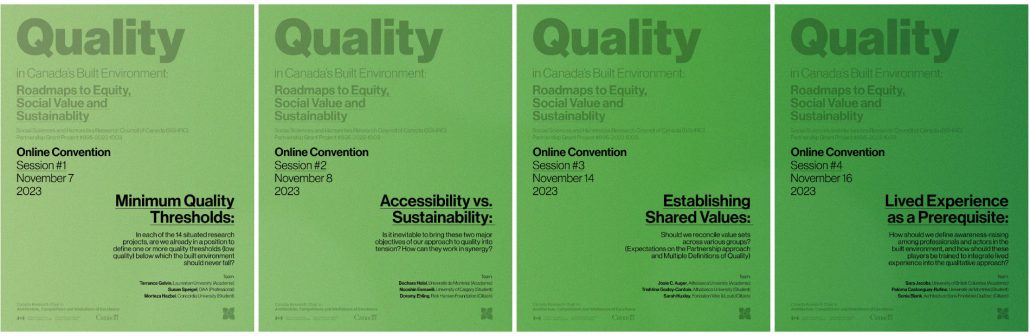
The CRC-ACME coordinates a research partnership funded by the SSHRC on quality (2022-2027)

Funded by the Social Sciences and Humanities Research Council of Canada until 2027, a major research partnership on quality in the built environment brings together – for the first time – 14 universities, 70 researchers and 68 public and private organizations at the municipal, provincial and national levels.

The total value of this partnership will be $8.6M ($2.5M from SSHRC, $6.1M from partners including $4.2M in-kind contributions). Such an investment confirms the commitment of all partners and the importance of the collaborative process.

The partnership will stimulate a vital dialog demonstrating how those active in considering and creating the built environment across Canada can contribute to a redefinition of quality that moves us to heightened equity, more social value and greater sustainability at a critical moment for our societies and for our planet.


Coordinated, from the University of Montreal, by the Canada Research Chair in Architecture, Competitions and Mediations of Excellence (CRC-ACME), the partnership Quality in Canada’s Built Environment: Roadmaps to Equity, Social Value and Sustainability addresses the diversity of public environments impacting the everyday life of millions of Canadians in urban spaces, buildings and landscapes.


The program has three aims:

  1. Analyzing the current limitations of environmental norms and sustainability models to bring us closer to the United NationsSustainable Development Goals (SDGs).
  2. Co-designing new paths to equity, diversity and inclusion in the built environment.
  3. Defining new frameworks for the definition of quality so as to enhance the social value of the built environment through roadmaps to quality.


To achieve these objectives, the partnership brings together methodologically 4 sets of stakeholders concerned with the use, scientific study, planning, design, construction and management of built environments:

  • Citizens (representatives of communities including minorities and underrepresented populations).
  • Cities (national, provincial and municipal actors in the public procurement of built environments).
  • Organizations assessing quality (professional associations, award granting institutions, councils, cities).
  • Universities (interdisciplinary research teams).


For the first time and at an unprecedented scale in the design disciplines in Canada, the project gathers 14 universities including all of the schools of architecture as well as most landscape architecture and environmental design departments. It mobilizes 23 disciplines concerned with the impact of built environments on citizens. Sixty-eight partner organizations including national institutions and not-for-profit will join in a conversation pertaining to 4 thematic clusters to address urgent considerations on quality relative to:

  1. Spatial justice and heightened quality of life.
  2. Integrated resilience, material culture and adaptative reuse.
  3. inclusive design for health, wellness, aging and special needs.
  4. processes and policies supporting the reinvention of built environments.


This extraordinary collaborative effort will stimulate training, internships and connections between hundreds of students and communities of practice. The partnership will engage in cross-sectoral co-creation of knowledge whose outcomes will take the form of “roadmaps to quality” (guidebooks, analyses of exemplary case studies, resources for design thinking and proposals for public policies, etc.). These will constitute a bilingual Living Atlas on Quality in the Built Environment set on a digital platform created with the support of the Canada Foundation for Innovation. Designed as a public forum on the social, economic and environmental value of quality, the Living Atlas will offer open access to repertories of award-winning projects, case studies, comparative analyses, scientific resources and articles, interpretative didactic podcasts, analogical maps and visualizations.

SSHRC Partnership Grant # 895-2022-1003


To see the full list of official co-applicants, collaborators, and partners:

Link to the SSHRC platform: 

https://www.sshrc-crsh.gc.ca/results-resultats/recipients-recipiendaires/2021/pg-sp-eng.aspx

Jean-Pierre Chupin denounces the confusion between online surveys and project competitions in an open letter relayed by La Presse, TVA and Kollectif

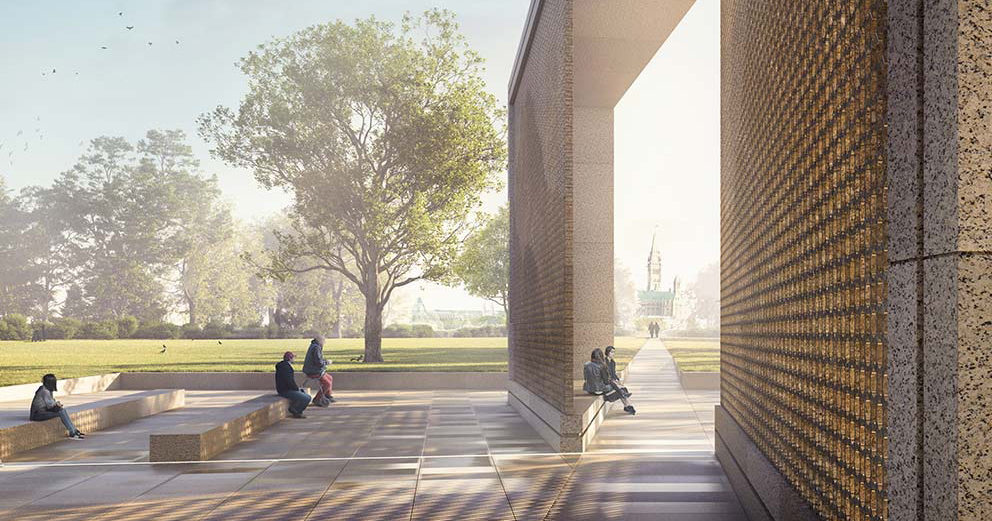
“Survey versus Competition: Simulacrum and Democracy” – Open letter co-signed by Jean-Pierre Chupin and Jacques White about the cancellation of the competition for the National Memorial to Canada’s Mission in Afghanistan.

When it comes to judging art or architecture projects, an online survey is a “mockery of democracy” that can’t replace either a design competition or a real jury! Strongly condemning Russian-organized elections in the occupied territories of Ukraine, Prime Minister Justin Trudeau recently declared loud and clear that these procedures constituted a “sham election”. By cancelling the result of a competition for a veterans’ monument, and replacing it with an online poll, his government has strayed dangerously into a travesty of democracy that we must now reflect on in order to better react and, above all, prevent from happening again.

First of all, the art, architecture and design communities have been incensed since the announcement, on June 19, of the cancellation of the results of the competition for the commemorative monument to Canada’s mission in Afghanistan. This frustration seems all the more legitimate given that the jury’s choice was overturned solely on the basis of an online survey that was conducive to all kinds of confusion. Claiming to want to give veterans a voice – an honourable thing if ever there was one – the federal government has discredited the jury’s decision in a design competition, sacrificing in the process a fundamental principle of our democracy: respect for a qualitative collective judgement by a representative, impartial and informed jury…

Read more on the Kollectif website

In the press:

See the article on TVA nouvelles, by Anne-Caroline Desplanques
See the article on Radio Canada, by Erik Chouinard
See the article in La Presse

See editorial in Canadian Architect by Elsa Lam

Survey versus Competition: Simulacrum and Democracy

About the cancellation of the competition for the memorial to Canada’s mission in Afghanistan by Jean-Pierre Chupin and Jacques White.


When it comes to judging art or architecture projects, an online survey is a “simulacrum of democracy” that cannot replace either a design competition or a real jury! Strongly condemning Russian-organized elections in the occupied territories of Ukraine, Prime Minister Justin Trudeau recently declared loud and clear that these procedures constituted a “simulacrum of election”. By cancelling the result of a competition for a veterans’ monument, and replacing it with an online survey, his government has dangerously lost its way in a travesty of democracy that we must now reflect on in order to better react and, above all, prevent from happening again.


Survey versus Competition: Simulacrum and Democracy

September 11, 2023

Jean-Pierre Chupin, Canada Research Chair in Architecture, Competitions and Mediations of Excellence, Université de Montréal (www.crc.umontreal.ca )

Jacques White, architect, retired professor at Université Laval, trainer and professional advisor for multidisciplinary and architectural competitions


Let us start by recalling that the art, architecture and design communities have been up in arms since the announcement, on June 19, of the cancellation of the competition for the commemorative monument to Canada’s mission in Afghanistan. Their frustration seems all the more legitimate given that the jury’s choice was overturned solely on the basis of an online survey that was rife with confusion. Claiming to give a voice to veterans – an honourable thing if ever there was one – the federal government has discredited the jury’s decision in a design competition, sacrificing in the process a fundamental principle of our democracy: respect for a qualitative collective judgement by a representative, impartial and informed jury.

If this case were to become a precedent for public commissions, no architect, designer or artist would agree to their proposals being fed to an online survey. To judge the complexity of projects for public spaces, buildings open to the public and, in this case, public monuments, a survey will never be as reliable, fair and transparent a procedure as a well-organized competition. As academics and architects well-versed in competition practices, it is important for us to denounce the dangerous confusion between opinion and judgment. An anonymous online survey, even if accompanied by a series of questions, is not the equivalent of the deliberations of a jury representing the interests of the public, made up of members informed of the multiple issues at stake, who debate all the proposals – themselves designed by multidisciplinary teams – for long hours, and make a well-argued consensus judgment in the name of the collective interest. We could sift through the survey questions, compare them with the competition documents and demonstrate without difficulty how those in the survey remain superficial, closed and non-operational, while those in the competition target fundamental questions, open to design and useful in leading to a solidly argued judgment.

The survey was carried out in a very short space of time, based on the distribution of project files, the complexity of which sometimes eludes the experts themselves. Even more dubious, the survey was controlled by so-called thematic questions, each formulation of which would have been an impossible design challenge for artists and designers. For example, one question asked which concept correctly expresses “the strong support offered by families, friends and communities at home during the mission.” Respondents were also asked which proposals: “acknowledge the efforts of Canadians in standing together with the Afghan people to help rebuild their country and encourage understanding of the significance and scope of Canada’s mission in Afghanistan.” Art, design and architecture cannot represent everything in a straightforward, simplistic and unequivocal way, especially when it comes to national symbolism. It would have been simpler and more honest to ask respondents to name their favourite project, but in doing so, it would have been more difficult to camouflage a purely political choice behind a cloud of opinions whose subjectivity would then have been obvious.

A poll is not a collective judgment! Only the qualitative judgment of a jury constitutes a deliberative construction – a collective intelligence – and this is what makes it one of the most important democratic devices. It is true that many competitions – but this was not one of them – include a clause allowing the client not to follow the jury’s recommendation. Its sole purpose is to counter any interference or irregularity in the competition process that might discredit the outcome. But in this case, the opposite is true: the sponsor interferes in a democratic process that it has previously approved by discrediting it, without valid justification. What would we say about a sports result or a film award that was cancelled out by an online survey after the fact? What if a democratic election were overturned by an anonymous online poll? What if a court judgement were overturned by an online survey pointing to the “real” culprit? Would not this all amount to revolting public lynching?

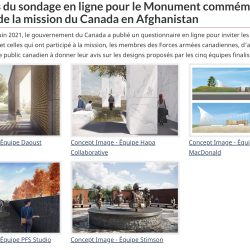
The honor of veterans is respected neither by the disreputable refutation of a well-established procedure, nor by a political choice with an unconvincing outcome. This is not the primary aim of our analysis, but comparing the two proposals the differences are clear, as are the tensions between abstraction and figuration they embody. It is quite clear that the choice of figurative imagery was presented as popular and “validated by veterans”, the better to place it in opposition to the choice of a jury of experts deemed abstract. The fact is that the jury included a veteran, a representative of military families and a former ambassador to Afghanistan, as well as a museum director, an architect, a historian and a landscape architect. There is even something contemptuous of the Canadian public in considering that a commemorative monument would be better served by literal images loaded with armour, helmets and shields, than by pared-down images evoking human sacrifice through timeless plays of light and shadow. With several other commemorative monument projects in the pipeline at Veterans Affairs Canada, it would be urgent to open the debate on contemporary creation in the service of heritage and citizens.

Everyone loses out in this sad affair. The veterans, first of all, because you do not express “Canada’s deep gratitude for the sacrifices made by Canadians who served in Afghanistan, including those Canadian Armed Forces members and civilians who lost their lives or were injured”* by flouting a procedure designed to protect boldness, integrity and impartiality. Then there is the government, which has a duty to set an example in all its procedures, and to respect the commitments set out in its own terms and conditions for awarding public contracts. Citizens are also the losers, as the solemnity of the visit to the monument will long be blurred by controversy and doubt, and it is indeed confidence in a qualitative judging procedure that is the loser in this monumental failure. Finally, let us not forget the teams who devoted long hours and put their soul and expertise into their proposal, legitimately believing in their chances of seeing it evaluated fairly, in compliance with the announced rules. We can all the more understand their immense disappointment that, contrary to good competition practice, the government has not yet had the courage to share the jury’s report.

This sad situation is not irreversible. We see several complementary outcomes:

First of all, and since public funds are also at stake in this affair, let us at the very least demand that the jury’s report be made public as quickly as possible. Out of respect for the competitors, the members of the jury, and in a way for all architects, designers and artists people of honor and principle at the service of the community this report will constitute the first stone of a real public debate, impossible without it.

But there’s more. Out of respect for the veterans, let’s ask the government to reverse this bad decision and award the project to the winning team.

Finally, to ensure that this situation does not taint future calls to design and build monuments, as well as public buildings and spaces, we call on the government to respect and even generalize a truly qualitative and democratic procedure: the juried project competition.


*Extract from the first question of the online survey.

https://www.canada.ca/fr/patrimoine-canadien/services/art-monuments/projets-cours/resultats-sondage-monument-afghanistan.html

Useful links:

https://www.veterans.gc.ca/fra/remembrance/memorials/afghanistan-monument

https://www.canada.ca/fr/anciens-combattants-canada/nouvelles/2023/06/le-gouvernement-du-canada-devoile-le-concept-de-design-selectionne-pour-le-monument-commemoratif-national-de-la-mission-du-canada-en-afghanistan.html

https://www.canada.ca/fr/patrimoine-canadien/services/art-monuments/projets-cours/resultats-sondage-monument-afghanistan.html

https://www.lapresse.ca/actualites/chroniques/2023-08-28/monument-commemoratif-de-la-mission-du-canada-en-afghanistan/quand-le-gouvernement-trudeau-ecarte-les-gagnants-du-podium.php

https://www.ledevoir.com/opinion/idees/797709/idees-desaveu-nie-excellence-art?


Petition launched by a group of artists:

https://www.change.org/p/monument-commémoratif-de-la-mission-du-canada-en-afghanistan-combattre-l-injustice

Conference-debate on the history of architecture schools in France and Quebec

Date: January 31, 2023, 5:30 pm.

Location: Amphitheatre 1120, Faculté de l’aménagement, Université de Montréal.

On the occasion of the publication in 2022 of L’architecture en ses écoles, une encyclopédie, we welcome Daniel Le Couédic, architect and historian, professor at the University of Western Brittany, and co-director of the book. Around Lucie K. Morisset, professor at UQAM and holder of the Canada Research Chair on Urban Heritage, this conference-debate will also bring together two Quebec contributors to the encyclopedia, François Giraldeau, honorary professor at UQAM’s School of Design, and Jean-Pierre Chupin, professor at UdeM’s School of Architecture and holder of the Canada Research Chair in Architecture, Competitions and Mediations of Excellence,

  • Anne-Marie Châtelet, Amandine Diener, Marie-Jeanne Dumont and Daniel Le Couédic, (eds.), L’architecture en ses écoles (une encyclopédie de l’enseignement de l’architecture au XXe siècle), Châteaulin, Éditions Locus Solus, 2022.
  • Jean-Pierre Chupin and François Giraldeau, article Québec, relations et échanges. p. 568.

Summary

With its 704 pages and 341 notes written by 147 authors, this work is the result of a vast collective effort to gather and deepen, in an unprecedented way, a state of knowledge that was fragmentary until now. This history of architectural education in France in the twentieth century addresses multiple dimensions – pedagogical, professional, territorial, political, institutional and material – and covers a range of institutions involved in architectural education, such as engineering schools.

In France, the history of architectural education was long reduced to its alleged shortcomings and to the story of the struggle of the champions of modernity against the École des Beaux-Arts in Paris. The earthquake of 1968 buried even the memory of that bygone era. The revival came from the United States, where the École had once enjoyed great prestige, but at first it concerned only the nineteenth century. It was not until the 1980s that the complexity of the things debated and experienced in the twentieth century began to be illuminated and, above all, that the investigations of architecture, its teaching, the profession and its practice were correlated.

In this movement, one rediscovered the long exacerbated debate between the architects defending the Parisian monopoly and their provincial colleagues, which had preluded the creation of the first regional schools in 1903. The Regional School of Rennes – which became the Regional School of Brittany in 1984 – was the second to open its doors; its history thus allows us to understand all the stages of this bumpy path which, well beyond architecture, provides information on the reinvention of higher education in France and on the role it played in the structuring of the national territory.

The discussion will also be based on another book by our guest: Le Couédic Daniel, Sauvage André, L’École d’architecture de Bretagne : Un siècle de fabrique des architectes, Châteaulin, Locus Solus, 2022.

RAIC and Canadian Architect magazine present a summary of the Calgary convention by Jean-Pierre Chupin

In a new RAIC journal article included in the most recent issue of Canadian Architect, Université de Montréal Professor and Project Director Jean-Pierre Chupin touches on new understandings of architectural quality and how the SSHRC research partnership has approached them so far.

Click here to read the article.

To quote this paper:
Chupin, Jean-Pierre, « The New Social Value of Architectural Quality » in Canadian Architect, August 2023, pp. 15-18.

Follow Canadian Architect on Twitter, Facebook, LinkedIn and Instagram to keep up with all publications.

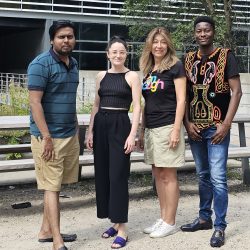
Students from Concordia, UdeM and Calgary participate in the Accessibility Professional Network Conference 2023 (RHF)

From left to right: Catherine Gauthier (MArch, Université de Montréal), Morteza Hazbei (PhD candidate, Concordia University), Jean-Pierre Chupin (UdeM), Doramy Ehling (CEO, Rick Hansen Foundation), Marco Pasqua (Rick Hansen Foundation), Nooshin Esmaeili (UCalgary)

On March 1-2, 2023, several student members of the SSHRC Quality Partnership were invited to participate in person or online in the annual APN2023 Building Together Symposium, which brought together industry leaders, accessibility professionals, and global thought leaders to discuss how we can continue to build an inclusive and accessible world for people of all ages and abilities. [Accessibility Professional Network 2023.](On March 1-2, 2023, several student members of the SSRC Quality Partnership were invited to participate in person or online in the annual APN2023 Building Together Symposium, which brought together industry leaders, accessibility professionals, and global thought leaders to discuss how we can continue to build an inclusive and accessible world for people of all ages and abilities. Accessibility Professional Network 2023.

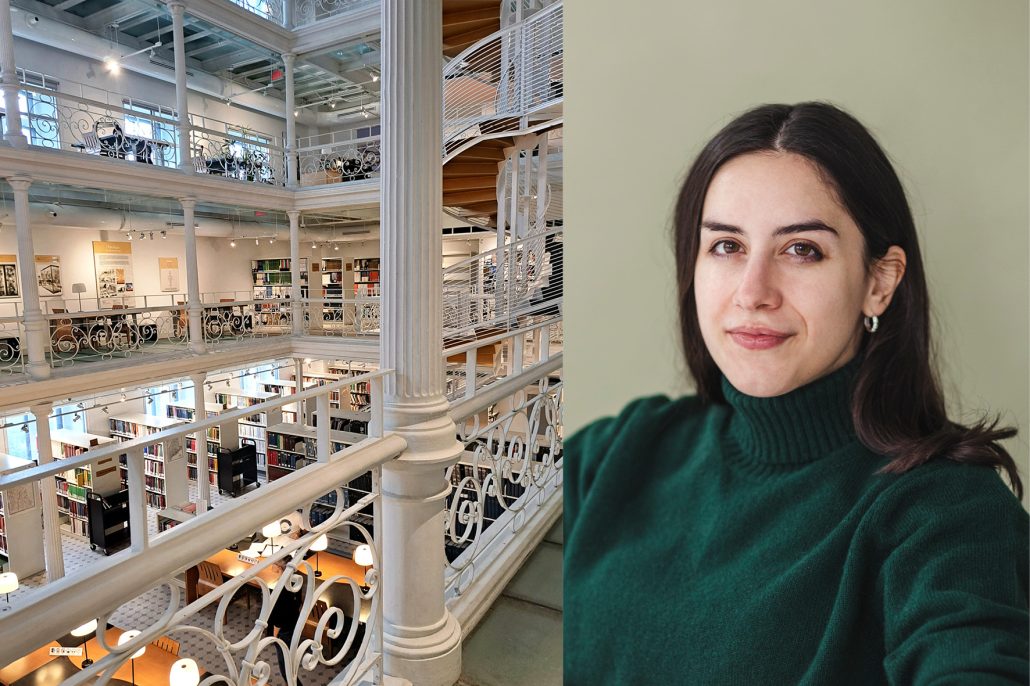
A new LEAP seminar: “Material Cultures through the filter of the Cecobois and Woodworks Awards” by Izabel Amaral

March 16, 2023. A seminar presented by Izabel Amaral (UdeM) around a SSHRC Insight Development Grant: (in collaboration with Carmela Cucuzzella (Concordia) and Jean-Pierre Chupin (UdeM)

An Ecology of Wood Cultures in Canada (20032020): comparing constructive cultures through awarded architectural designs

At the  intersection of  architectural theory and  cultural studies, this  research investigates wood  architecture as a symbolic universe that allows us to study the presence of nature in human culture. This research will theorize the diversity of expressions of quality in Canadian architecture, from the standpoint of environmental preoccupation, building culture and architectural expression. Considering wood architecture as a form of “cultural ecology”, it has the potential to reveal how Canadian cultures represent and symbolize their relations to the land and natural resources, as well as the cultures of its founding peoples.

Notwithstanding the interest in wood as a major alternative to fossil fuelbased construction materials, this research will highlight the symbolic spectrum of wood buildings, which ranges from local and indigenous traditions to ecological aesthetics, representing forms of making that rely both on traditional architectural practice or recent building technologies and computeraided design. We aim to better interpret and understand how advancements in architectural practice and building techniques affect the way architecture is envisioned and materialized in Canada during the past decades. In parallel to studying the influence of environmental considerations to  architectural forms in  Canada, we  will make sense of  a  dissonance within the theory of architecture between ideas about the interdependency or autonomy of architectural form (visual appearance), material (what it is made of) and meaning (messages and ideals expressed).

Video of the roundtable: What is an architecture award worth?

[vc_raw_html]JTNDZGl2JTIwc3R5bGUlM0QlMjJ0ZXh0LWFsaWduJTNBJTIwY2VudGVyJTNCJTIyJTNFJTBBJTNDaWZyYW1lJTIwdGl0bGUlM0QlMjJ2aW1lby1wbGF5ZXIlMjIlMjBzcmMlM0QlMjJodHRwcyUzQSUyRiUyRnBsYXllci52aW1lby5jb20lMkZ2aWRlbyUyRjcwMDUyMDkzNSUzRmglM0RkOTVhMWViMWFiJTI2YW1wJTIyJTIwd2lkdGglM0QlMjI2NDAlMjIlMjBoZWlnaHQlM0QlMjIzNjAlMjIlMjBmcmFtZWJvcmRlciUzRCUyMjAlMjIlMjBhbGxvd2Z1bGxzY3JlZW4lM0UlM0MlMkZpZnJhbWUlM0UlMEElM0MlMkZkaXYlM0U=[/vc_raw_html]This debate was organized at the BAnQ’s National Archives in Montreal (535 Viger Avenue East) on November 24, 2022.

Once a symbol of excellence and exception, architecture and design awards, which aim to reward achievements, have multiplied exponentially in recent years. We no longer count the number of companies, associations, municipalities and specialized publications that have set up their own awards, many of which have greatly multiplied their categories over the years. The situation is such that we can now speak of a veritable awards “industry”, both in Quebec and internationally.
In this context, we may wonder about the value of these awards. Do they always reward excellence? Do the entries focus excessively on aesthetics, or even the “Instagrammable” side of architecture, rather than on the public experience? Why do architectural firms feel the need to participate? How can we ensure the real value of an architecture award?The event was organized by Kollectif, in partnership with Jean-Pierre Chupin, Canada Research Chair in Architecture, Competitions and Mediations of Excellence (Université de Montréal) and co-editor of the collective book The Rise of Awards in Architecture (Vernon Press, 2022) with Carmela Cucuzzella and Georges Adamczyk.Presenter: Marc-André Carignan, Content Manager for Kollectif
Moderator: Jean-Pierre Chupin, Canada Research Chair in Architecture, Competitions and Mediations of Excellence, Université de Montréal

Our panelists:

Our guests of honour:

Video production:

  • Video editing and recording: Jonathan Haxhe, M.A. in communication, Université de Montréal.
  • Recording: Théo Pagé-Robert, Bachelor of Architecture, Université de Montréal.

Funding: Canada Research Chair in Architecture, Competitions and Mediations of Excellence.<div style=”text-align: center;”>
<iframe title=”vimeo-player” src=”https://player.vimeo.com/video/700520935?h=d95a1eb1ab&amp” width=”640″ height=”360″ frameborder=”0″ allowfullscreen></iframe>
</div>