

Exhibition presented from September 24, 2020 to January 20, 2021 at the Centre de design de l’UQAM in Montreal (dir. Louise Pelletier) thanks to a collaboration between LABÉCOLE, LEAP, CRC-ACME and Centre de design. all details here
Non classé
The 5 competitions of the LABécole fully documented exclusively on the CCC
As part of a collaboration with the LABécole organization, the Canadian Competitons Catalogue is the first to deliver all 160 projects submitted in 2019 to the 5 competitions for the construction or expansion of elementary school in Shefford, Rimouski, Gatineau, Maskinongé and Saguenay. The official unveiling of the winners took place on Monday, August 24.
LAB-ÉCOLE | Agrandissement et rénovation de l’école Saint-Joseph à Maskinongé
LAB-ÉCOLE | Rénovation et agrandissement de l’école primaire Pierre Elliott Trudeau à Gatineau
LAB-ÉCOLE | Construction d’une nouvelle école primaire à Shefford
LAB-ÉCOLE | Construction d’une nouvelle école primaire à Rimouski
“In 2020, judging by the number of architecture competitions held in Quebec over the past two decades and the number of award-winning buildings, it is easier to find an excellent library than an elementary school worthy of the name. This series of 5 competitions – open and in two phases – organized by the LAB-École organization therefore confronted two contradictory convictions: the certainty that places of schooling forge and shape what we are since early childhood and this conviction, widespread among public decision-makers, that we could basically study and teach anywhere. Particularly well organized by LAB-École, these competitions show, on the contrary, that architecture is not a luxury, but a necessity. For contexts as different as Saguenay, Maskinongé, Rimouski, Gatineau and Shefford, the proposals prove to be rich in reflections demonstrating that the question of primary school remains complex and cannot be circumscribed in models that can be repeated – in blue, wood or aluminum – whatever the context.”
Thanks to the teams of students from Université de Montréal working on the CCC and to CRC-ACME for this intense digital documentation work.
Several LEAP researchers participated in 27 brainstorming sessions on the determinants of quality in architecture at the invitation of CRC-ACME
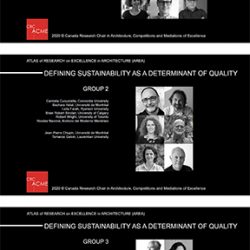
For three weeks in May 2020, 3 groups of researchers and professionals across Canada participated in 3 brainstorming sessions per week, with 9 Zoom sessions per group, for a total of 27 sessions. This series of remote exchanges is part of both the establishment of a large collaborative and research network on the quality of built environments (AREA) and the design of a digital platform or « Atlas of Excellence in Architecture » capable of supporting long-term research on the understanding and dissemination of best practices in the Canadian context (AEA). This database is decentralized and in open access. Coordination: Jean-Pierre Chupin (Université de Montréal), Terrance Galvin (Laurentian University) Doctoral students and assistants: Mandana Bafghinia, Aurélien Catros, Sherif Goubran, Firdous Nizar, Lucie Palombi, Alexandra Paré, Anne-Lise Belbezet
Understanding the Awards of Excellence (Issue 191 of Architecture Québec magazine) : Researchers from LEAP and the Canada Research Chair in Architecture, Competitions and Mediations of Excellence present some results of their recent work on awards of excellence in all areas of design
This special issue on Awards of Excellence does not introduce new winners or reveal any results that were not previously known. Its purpose is to call for more attention to a phenomenon – the celebration of excellence – on which there is strangely little critical attention. What is to be understood from the plethora of award-winning projects, achievements and practices year after year? Certainly, the images are part of an intense ballet at each local, regional or national award ceremony. Images of architectural excellence, no doubt about it. However, it is necessary to “freeze frame” the images to begin to question the definitions of quality that they are supposed to summarize, symbolize, perhaps measure. The reader who would like to be convinced of the extent of the phenomenon in a few figures can start this issue at the end, as we draw up an unprecedented statistical portrait of it, revealing in particular the exponential increase in the number of organizers and prizes in a decade. Georges Adamczyk first of all proposes to shift the “waiting horizon” from the reception of architects or the public to the interest of the academic world. In fact, he takes award-winning projects as models: “projects that are judged excellent by their peers for their exemplary aesthetic and functional qualities are also potential projects for learning about design and production in architecture”. David Theodore places the Quebec awards in a broader Canadian context. While Quebec architects do indeed distinguish themselves in Canada and even abroad, his survey shows that it is certain types of buildings and architectural practices that are distinguished, rather than excellence or the best buildings in general. Paradoxically, he wonders whether the awards really promote good architecture. This is confirmed by Aurélien Catros‘ reflections on heritage distinctions. The recent history of the categories of excellence in conservation first reveals the fluctuations of the underlying policies. And what could be more up-to-date than a policy for school architecture? On this point, Alexandra Paré‘s retrospective look shows that school architecture remains a poor relation of awards. She agrees with the conclusions of Theodore and Adamczyk in inviting us to conceive of prices as a true school of architectural quality. The articles by Sherif Goubran and Carmela Cucuzzella question the growing importance of ecological and environmental criteria in contemporary quality recognition. The statistics compiled by Goubran shed light on the multiplication of definitions of sustainability. Cucuzzella’s analyses show in detail that certain awards literally force the use of ever more “eco-didactic” visibility. She concludes that awards would not only play a recognition function, they would determine a form of excellence. In essence, this inversion is the game proposed by Lucie Palombi who, by temporarily obliterating the images of the prize-winning projects, wonders what a foreign visitor to three prize-winning libraries might understand by considering only the rare comments of the juries. We’ll let you guess. For as long as the lists of prize-winning projects are not accompanied by the reasons, analyses, judging criteria and therefore the jury reports, there is a risk that the prizes will remain nothing more than nice celebrations and not stages in the full and effective recognition of an “architectural quality policy”. Editorial: Prices, freeze frame! (Jean-Pierre Chupin, Professor, Université de Montréal) Taking Home the Prize: Distinguishing Québec in Architectural Awards (David Theodore, Professor, McGill University) Three award-winning libraries (the reverse visit) (Lucie Palombi, doctoral student, Université de Montréal) School architecture, the poor relation of prizes (Alexandra Paré, doctoral student, Université de Montréal) Learning from excellence in residential architecture (Georges Adamczyk, Professor, Université de Montréal) Quebec in the Canadian sustainable development awards concert (Sherif Goubran, PhD student, Concordia University) The allegory of heritage through the filter of awards of excellence (Aurélien Catros, doctoral student, Université de Montréal) What is the purpose of architectural awards? (Jean-Pierre Chupin, Professor, Université de Montréal) “Eco-education”: Are “green awards” forcing the visibility of green devices? (Carmela Cucuzzella, Professor, Concordia University)
ARCHIVES OF EXEMPLARITY IN ARCHITECTURE AND THE BUILT ENVIRONMENT (AREA)

The Archives of Exemplarity in Architecture and the Built Environment (AREA) is an open construction site!
AREA-BE is an initiative of the Canada Research Chair in Architecture, Competitions and Mediations for Excellence (CRC-ACME), held by Jean-Pierre Chupin, Ph.D. , architect MOAQ, MIRAC, DPLG, DipArch (2), Professor at Université de Montréal. This initiative is actively supported by a network of Canadian and international scholars.
The current website of the AREA (www.architecture-excellence.org) has been officially launched in November 2019 for information purposes.
The AREA website foreshadows an important documentation and research platform to be launched in 2021 / 2022
This long-term initiative is supported by the Canada Foundation for Innovation and the Social Sciences and Humanities Research Council of Canada through the Canada Research Chairs Program.
In the coming years, the establishment of an AREA partnership of researchers based in Canadian schools of architecture and research universities will ensure the reliability, regular updating and sustainability of this scientific platform regrouping resources, knowledge transfers and analyzes on best examples of architectural design, landscape design and urban design in Canada.
Thanks to the contribution of institutions delivering awards and to professional teams giving access to data on projects and buildings, researchers and students will be able to contribute to a better understanding of the current evolution of quality in the built environment. The data, information, analyzes, comparisons, visualizations that will be progressively delivered – in open access – on the AREA platform will take advantage of award-winning projects and buildings in Canada, from year to year, in order to identify and better understand best practices.
The AREA collective platform will be meant to provide scientific data in order to support education, policies, actions and mediations aiming at excellence in the built environment.
More information on CRC-ACME’s program can be found at www.crc.umontreal.ca/en/ as well as definitions, data and insights in the “science blog” section of the same site.
Lucie Palombi, doctoral student, receives a FRQSC scholarship for her research project

Lucie Palombi, individualized doctoral student under the supervision of Jean-Pierre Chupin, receives a doctoral research scholarship from the Fonds de Recherche Société et Culture du Québec, worth $77,000 over 4 years (from 2020 to 2024) for the research project entitled “La mise en compétition de l’écriture en architecture. Herméneutique du texte gagnant et de l’ouvrage primé”, attached to the Research Chair in Architecture, Competitions and Mediations of Excellence.
Mandana Bafghinia, doctoral student, receives a Cardinal and Hardy scholarship for her research project

Mandana Bafghinia, doctoral student in architecture under the direction of Jean-Pierre Chupin, receives the Cardinal and Hardy scholarship, valued at $8,000, for the research project “Habiter les toits, dialogue in the shadow of high-rise buildings”, attached to the Research Chair in Architecture, Competitions and Mediations of Excellence
Paper in open access in FOOTPRINT (Delft Architecture Theory Journal) #26 (2020) : “This is not a Nest: Transcultural Metaphors and the Paradoxical Politics of International Competitions”

This is Not a Nest: Transcultural Metaphors and the Paradoxical Politics of International Competitions
Jean-Pierre Chupin, Université de MontréalPublished in:
Footprint, Delft Architectural Theory Journal, issue #26, Vol 14, n1, Spring 2020. Pages: 63-82
Abstract
Although the architecture competition has been analysed through a number of rhetorical lenses, the recurring production of transcultural metaphors, particularly in international competitions, remains to be addressed as a genuine disciplinary phenomenon. The hypothesis of competitions as contact zones is particularly appropriate for the study of international events, in which competitors forge broad analogical figures to bridge cultural differences. Recent studies in the cognitive understanding of analogical matrices have considerably reinforced the theories on metaphors. Our analytical grid characterises analogical matrices to identify levels of symbolic operations through the differentiation of formal, structural and conceptual analogies. We first dig into a sample of competition project nicknames (Crystal, Bird’s Nest, DNA, Cloud, Lace, Stealth, etc.) to confirm that these tropes have a paradoxical status at the intersection of architects’ intents and public expectations. We then summarise an in-depth hermeneutical discourse analysis of forty North American international competitions. This indicates a fourfold series of expectations to which competitors hope to provide answers in an international ‘conflict of interpretations’. Adhering to the theory of speech acts, we suggest that performative metaphors in competitions appear less as indicators of designers’ intentions than as products of the broader context surrounding competitions themselves. We conclude with a proposed grid indexing four types of contact zones in which metaphorical relationships are actively created and not just repeated.
Keywords
International Competitions, Analogies, Metaphors, Analogical Matrices, Discourse Analysis, Speech Acts
DOWNLOAD IN .PDF
