
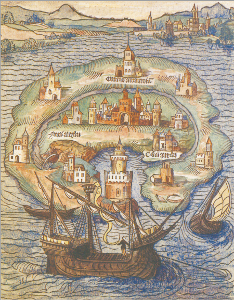
After presenting a short history of the Canadian Competitions Catalogue (CCC) (www.ccc.umontreal.ca), we propose to reflect on a decade of personal experience in the building and use of digital libraries of competitions projects, here presented as “Electronic Libraries of Projects” (ELP). From a more epistemological perspective, we question the problematic location of the entity “clients” in the ontological structure of any competition database as an invitation to recognize that the logical structure of a specifically designed and long-tested relational database, such as the CCC, already offers itself as a theoretical reconstruction of this complex temporal phenomenon called “design competition.” We conclude with an appeal to develop and connect multiple libraries of competition projects, at an international level, as a form of recognition of the inherent value of the numerous unbuilt architectures produced through competitions. Indeed, this world of possibilities, solutions and ideas should be seen as contributing to an extensive reservoir of “potential architecture” partaking of a collective legacy, if not a world heritage, of environmental design projects.
Archives : Téléchargements
Chupin, Jean-Pierre, Lino José Gomes Alves, Jason Goorts, « Le ciel des idées, l’horizon des connaissances », in Europan France, Innover dialoguer réaliser (1988 – 2007), Paris, éditions Jean-Michel Place, 2007. Pages: 39 à 52
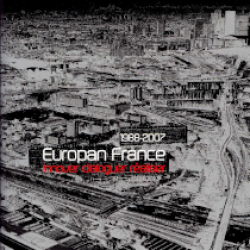
On considère généralement que les concours Europan sont des concours d’idées, mais cette appellation ne va pas sans ambiguïtés. Après tout, que doit-on attendre d’un concours d’idées : une intention, une partie d’un projet, ou la solution d’un problème? À l’inverse, ne devrait-on pas commencer par reconnaître qu’une idée correspond plus souvent à la formulation originale d’un problème d’architecture, aux dimensions anthropologiques, technologiques ou esthétiques, qu’à une « solution », fusse-t-elle provisoire ?
Chupin, Jean-Pierre, « L’analogie ou les écarts de genèse du projet d’architecture » in Genesis (revue de génétique littéraire du CNRS), n° 14, numéro spécial portant sur l’architecture en collaboration avec le Centre Canadien d’Architecture. (Sous la direction de Pierre-Marc de Biasi et Réjean Legault). Paris, septembre 2000. Pages : 67 à 91
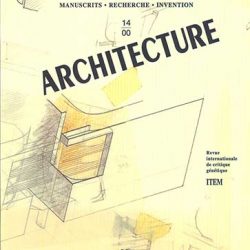
L’ambition d’une explicitation méthodique de la genèse du projet d’architecture est une initiative qui revient en grande partie aux chercheurs anglo-saxons. Or, contrairement à ce que l’on pense parfois dans les écoles françaises, la filière des « design methods » est encore très active. L’histoire des approches méthodologiques de ces trente dernières années est d’ailleurs si riche qu’elle permet déjà de poser quelques balises, sinon quelques phares, à l’intention des voyageurs désireux de naviguer dans les eaux troubles des documents de la conception architecturale. C’est l’intention du présent article que de signaler quelques impasses caractéristiques, mais également quelques représentations parmi les plus pérennes, des tentatives de modélisation des phases fondamentales de la conception. Ceci ne veut pas dire que l’on confonde ici les perspectives génétiques et méthodologiques : il est encore trop tôt pour se prononcer sur l’avenir d’un tel espace analogique. Plus simplement, on admettra que le fait d’interroger la genèse d’un document de projet revient inévitablement à se confronter à la genèse d’une conception, à la formulation souvent implicite d’une modélisation, et qu’en la matière il est des circularités à éviter et d’autres, inévitables.

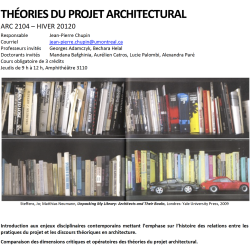
Article in FOOTPRINT (Delft Architecture Theory Journal) #26 (2020) : « This is not a Nest: Transcultural Metaphors and the Paradoxical Politics of International Competitions »

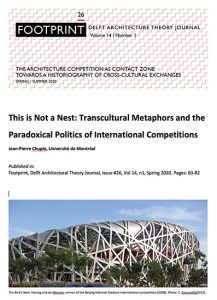
This is Not a Nest: Transcultural Metaphors and the Paradoxical Politics of International Competitions
Jean-Pierre Chupin, Université de Montréal
Published in:
Footprint, Delft Architectural Theory Journal, issue #26, Vol 14, n1, Spring 2020. Pages: 63-82
Although the architecture competition has been analysed through a number of rhetorical lenses, the recurring production of transcultural metaphors, particularly in international competitions, remains to be addressed as a genuine disciplinary phenomenon. The hypothesis of competitions as contact zones is particularly appropriate for the study of international events, in which competitors forge broad analogical figures to bridge cultural differences. Recent studies in the cognitive understanding of analogical matrices have considerably reinforced the theories on metaphors. Our analytical grid characterises analogical matrices to identify levels of symbolic operations through the differentiation of formal, structural and conceptual analogies. We first dig into a sample of competition project nicknames (Crystal, Bird’s Nest, DNA, Cloud, Lace, Stealth, etc.) to confirm that these tropes have a paradoxical status at the intersection of architects’ intents and public expectations. We then summarise an in-depth hermeneutical discourse analysis of forty North American international competitions. This indicates a fourfold series of expectations to which competitors hope to provide answers in an international ‘conflict of interpretations’. Adhering to the theory of speech acts, we suggest that performative metaphors in competitions appear less as indicators of designers’ intentions than as products of the broader context surrounding competitions themselves. We conclude with a proposed grid indexing four types of contact zones in which metaphorical relationships are actively created and not just repeated.
Keywords: International Competitions, Analogies, Metaphors, Analogical Matrices, Discourse Analysis, Speech Acts
« When Boston is not Boston: The useful lies of reconstructive game models » written by Aurélien Catros and Maxime Leblanc, respectively PhD candidates in Architecture at UdeM and McGill

Using qualitative comparative analysis, this article assesses how faithfully the reconstructive game models (RGMs) used in video games simulate historic cities. Employing Kevin Lynch’s concept of imageability, it looks in particular at similarities and differences between a 1775 map of Boston and the RGM of the city featured in Ubisoft’s Assassin’s Creed III. By comparing the construction of landmarks, paths, nodes, edges and districts within the game model to the historic conditions recorded on the map, it demonstrates that a feeling of verisimilitude is achieved not through complete accuracy but through specific combinations of sufficiently accurate historic elements. Based on these findings, it discusses the theoretical implications of designing RGMs and sheds light on the use of architectural heritage reconstitutions as an educational component in video games.
REFERENCE:
Catros, Aurélien and Leblanc, Maxime, “When Boston Isn’t Boston: Useful Lies of Reconstructive Game Models”, Traditional Dwellings and Settlements Review (TDSR), VOLUME XXXII, # II, 2021, 23-37.
Three Types of Architectural Educational Strategies (AES) in Sustainable Buildings for Learning Environments in Canada, an article by Jean-Pierre Chupin, Morteza Hazbei and Karl-Antoine Pelchat
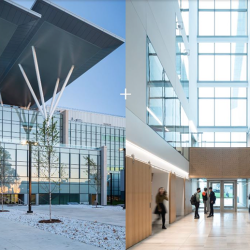
This article explores a trend provisionally called “eco-didacticism” observable for nearly 15 years in art, design and architecture. The corpus concentrates on learning centres as buildings meant to diffuse advanced knowledge in the field of sustainable architecture. We found evidence of additional educational intentions to the pedagogical or scientific programs that these buildings have already been mandated to host and support. A variety of practices or devices have sometimes been added to the architecture, sometimes integrated, while others determine the overall structuring of these educational buildings. Seven cases of “learning centres” built in Canada between 2004 and 2018 have been screened through three epistemological filters distinguishing forms of “architectural didactics”: 1—a labeling often quantitative approach, 2—an experiential or practical approach, 3—a visually narrative or iconic approach. While outlining definitions of these Architectural Educational Strategies (AES), we offer initial explanations for their distinctive features. It appears that architects, designers and critics altogether operate on the belief that forms of architectural communication can operate as elements of a language that would be accessible to non-experts. Our conclusion indicates how future research could question the very possibility of giving lessons through formal language and aesthetic features.
REFERENCE:
Chupin, J. P., Hazbei, M., & Pelchat, K. A. (2021). Three Types of Architectural Educational Strategies (AES) in Sustainable Buildings for Learning Environments in Canada. Sustainability, 13(15), 8166. https://doi.org/10.3390/su13158166